




A thin silicone patch developed by Norwegian researchers uses changes in reflected colour to capture pulse waveforms through an ordinary smartphone camera, without electronics or a battery in the patch.
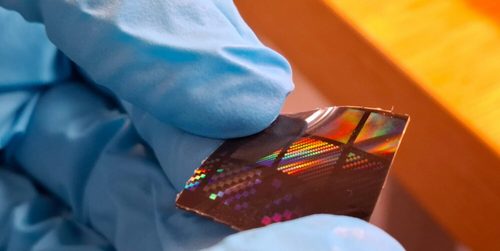
Researchers at the Norwegian University of Science and Technology (NTNU) have developed a thin silicone patch that changes colour with each heartbeat, allowing a smartphone camera to record pulse waveforms. The patch contains no battery, electronic components or wires. In tests involving 13 volunteers, the pulse waveforms extracted from smartphone videos showed a correlation of 0.94 with a clinical reference measurement, according to the researchers.

This device consists of a very thin layer of polydimethylsiloxane (PDMS), a type of flexible silicone, which is applied to the radial artery in the wrist. One side of the layer has a nanostructured grating that reflects various wavelengths, or colors, of light. When the artery expands with each heart beat, the skin around it stretches and affects the spacing between these ridges, thus changing the wavelength that is reflected from the layer. Changes in red, green and blue color components of the reflected light are detected through video analysis, allowing the extraction of the pulse wave shape. It was noted that stretching of 2 per cent caused a change of 9 per cent in the wavelength reflection intensity and remained stable for 1,000 cycles.
Unlike conventional photoplethysmography (PPG) sensors, which use light sources and electronic detectors to measure changes in blood volume, this approach relies on the smartphone camera to capture the optical changes. The researchers say the patch performed better than active reflectance PPG, imaging PPG and piezoelectric pulse sensors during comparative measurements. However, the approach shifts much of the signal-processing work to the smartphone. The team also acknowledges that camera differences and variations in skin tone require further investigation.
The patch has a second textured surface with an adhesive pattern inspired by octopus suckers. According to the researchers, this design improved shear adhesion to skin by 65 per cent compared with a flat film. Both surfaces are produced using large-area nanoimprinting, and the researchers report that fabrication was possible outside cleanroom conditions. This could simplify manufacturing.
It still is an experimental technology and has not been approved as a medical device. The experiments were conducted on a small sample size of healthy individuals; accuracy of this test has not been verified yet. Furthermore, motion of the wrist and the skin around it affects color changes and it becomes hard to differentiate between the two. Although there is some possibility for inexpensive pulse measurement technology in places where no medical devices are available, more research is required to deploy the technology.
For more information, click here.
