




New theoretical research examines how relativistic effects can turn scattered laser light into a source of drag on high-speed spacecraft sails.
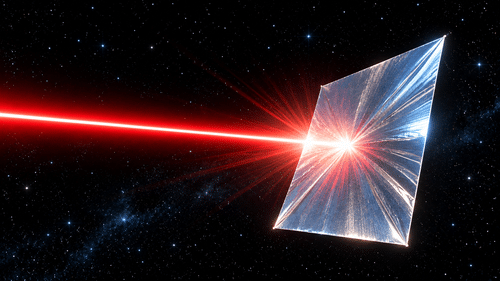
Laser sails rely on the momentum of light to accelerate spacecraft without any need of onboard fuel. But, a new theoretical study by the researchers from Harbin Institute of Technology suggests that the force acting on these sails changes as they get closer to the speed of light. At around 75 per cent of light speed, scattered light can start creating the drag rather than helping to push the spacecraft forward.
Researchers Chao Shen and Jiaze Li looked at three parts of light interacting with a sail: incoming light, mirror-like reflection, and diffuse scattering from a rough surface. As the sail moves away from the laser, the Doppler effect reduces the energy of the incoming light, reducing the thrust. We find that the incoming light has the strongest force out of the three interactions, then reflection and diffuse scattering has the weakest force.
The surprising thing is that there is an effect called relativistic aberration which changes the apparent direction of light if something is moving very fast. An external observer sees the photons moving more and more forward as the sail accelerates. Photons have momentum, so when they scatter they push the sail backward. At high speeds this effect makes diffuse scattering a source of drag.
This doesn’t prevent the spacecraft from accelerating. All three of these would combine to give a resultant force. However as the velocity of the spacecraft increases, its rate of acceleration decreases. It is pointed out that the majority of increase in velocity occurs during this acceleration period.
One advantage of such sails is that no fuel would need to be carried. Breakthrough Starshot is one proposal where high power lasers on the Earth’s surface could accelerate tiny spacecraft to a significant fraction of the speed of light to travel to other stars. This paper discusses some theoretical aspects of one issue that could affect these spacecraft.
For more information, click here.
