





Designed for automotive safety systems, the radar chip supports centralised processing and high-speed transfer of radar data.
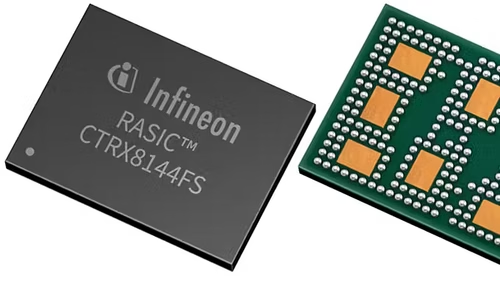
Infineon Technologies AG has launched the RASICTM CTRX8144FS, a 76–81 GHz radar MMIC with four transmit (Tx) and four receive channels (Rx). The chip is intended for two types of automotive radar sensors: front radar and corner radar. Radar chips also provide the sensing capabilities needed by software-controlled vehicle systems.
The radar is AEC-Q100 Grade 1-qualified and developed as an ISO 26262 Safety Element out of Context (SEooC). It also supports safety requirements up to ASIL B for the above-mentioned ADAS applications. The company claims that the device supports direct communication with a central compute unit, which can help simplify sensor design and minimise the need for additional companion components.
The device comes with integrated radio-frequency (RF) waveguide ports, which reduce signal loss and eliminate complex high-frequency transitions on printed circuit boards (PCBs). The radar also supports stable operation across the automotive temperature range due to its low thermal resistance. The device also features integrated diagnostics to continuously monitor radio-frequency performance and internal temperatures.
Key technical features of Infineon’s CTRX8144FS include:
- Supports bandwidths of up to 4 GHz for high-resolution radar sensing.
- Uses fast frequency changes of up to 200 MHz/μs to detect and track objects quickly.
- Has a CSI-2 interface for transferring raw radar data at speeds of up to 1.2 Gbps per lane.
- Includes a digital PLL and flexible sequencer to support different radar configurations.
- Has built-in power management and LDOs, reducing the need for external components.
“Centralised processing shifts signal processing from the radar sensor to a central ADAS compute unit,” said Andreas Kopetz, Head of the Radar Product Line at Infineon. “By removing memory and computing constraints at sensor level, the architecture enables larger radar data sets and more advanced algorithms. This can support improvements in detection range, sensitivity and target separation. The resulting high-quality radar data provides a strong foundation for AI- and machine-learning-based sensor fusion.”
Click here for the original announcement.
