





A self-folding drone can squeeze through gaps less than half its normal width and return to its original shape during flight.
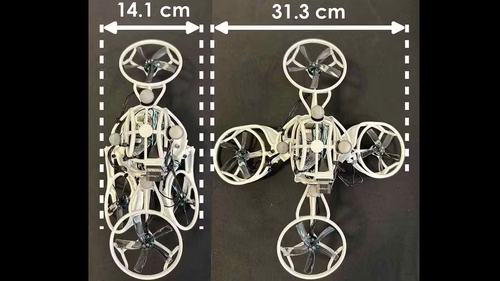
Researchers at the Norwegian University of Science and Technology, ETH Zurich, and the University of Bonn have developed a quadcopter that can pass through gaps narrower than its normal width without stopping or manually folding its body. The drone has four arms arranged like a plus sign. The front and rear arms are rigid, meaning they cannot bend. The two side arms, however, have flexible joints that allow them to fold.
When the drone flies towards an opening that is narrower than its full width, its side arms touch the edges of the opening. The contact pushes the flexible joints, causing the two side arms to fold inwards. Once the drone clears the opening, the side arms spring back to their original positions.
The arms have to be rigid to withstand the forces coming from the propellers during normal flight. To achieve this, the team used elastic rolling cam joints. The drone has two spring-loaded cams with interlocking teeth that prevent them from slipping. The drone can bend with little effort beyond a certain point by carefully designing the profiles of the cams.
The researchers needed to find the best design for the drone so that it could fold its arms when passing through narrow openings and return to its normal shape afterwards. Therefore, the researchers developed an automated design optimisation process. It considers 26 different parameters and evaluates different combinations to identify a suitable drone design.

The researchers created several possible drone designs, each with different arm lengths, propeller positions and joint properties. Each design was tested in NVIDIA’s Isaac Lab simulation environment. The drone had to fly through 100 openings of different widths to see how well it could squeeze through them. The researchers recorded how each design performed. This information was fed back into the optimisation algorithm, which used the results to create and evaluate better designs in the next round. The team evaluated 800 different designs in approximately 18 hours using a laptop with an NVIDIA RTX 4080 GPU. The final design could reduce its width from 31.3 cm to 14.1 cm when passing through a narrow opening.
Compared with the same type of drone, this prototype consumed less than one per cent more power and had two millimetres of additional position-tracking error during unobstructed flight.