




The new type of n-type polymer semiconductor possesses both 100 percent stretchability and high charge mobility, being able to survive up to 1,000 stretching cycles without breaking.
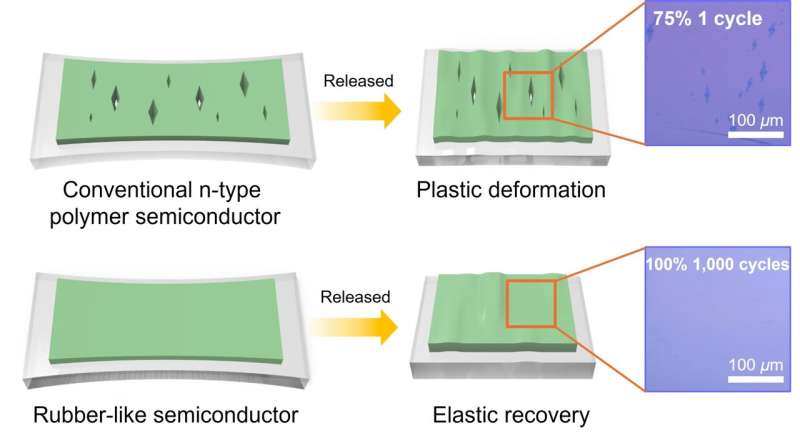
A rubber-like n-type polymer semiconductor has been developed that combines high electrical performance with 100 percent stretchability and can retain its original form even after 1,000 stretching cycles. It has been developed by researchers at Seoul National University, Queensland University of Technology, and Fudan University.
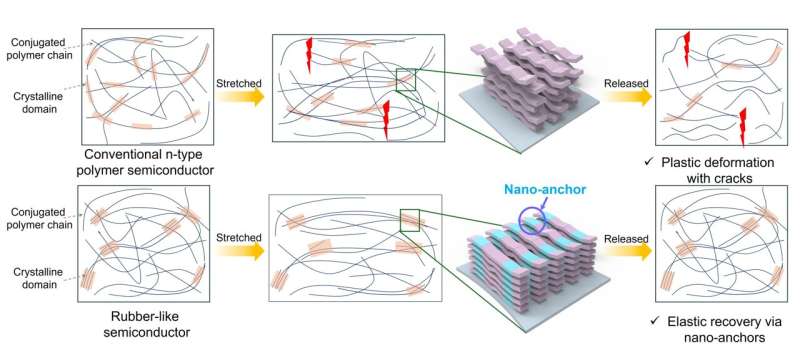
Approximately 10% of an insoluble molecule structure was utilized by the semiconductor for the formation of nanoscale anchors that act as glue for polymer chains. Such anchors enable recovery of the material back to its original structure during stretching along with retaining paths of electricity, thereby solving a major problem faced by conventional stretchable n-type semiconductors.
The measured electrical values were approximately twice the charge carrier mobility compared to the conventional stretchable n-type semiconductors when stretched to twice the original length. The charge carrier mobility of this material was similar to amorphous silicon used in display driving. Unlike the conventional materials which crack after stretching only once up to 1.75 times the original length, the new material did not crack after being stretched 1,000 times to twice the original length.
The researchers created a stretchable phototransistor by combining a stretchable semiconductor, flexible electrodes, and elastic substrate into a single unit. While traditional phototransistors might experience loss in their electrical functions when stretched or bent, the newly created phototransistor was capable of maintaining light detection and signal amplification while being strained at 100%, meaning it could be stretched to double its initial size without losing its capabilities.
The phototransistor is able to sense low-intensity light and transform it into amplified electric output. It gained a photoconductive gain of more than 29 charge carriers per incident photon, which means that each photon falling on this device generated more than 29 charge carriers, contributing to electric current. This helps with sensing the weak light and thus makes it suitable for use in wearable optical devices, e-skin, flexible cameras, and other stretchable optoelectronic applications.
