
This water level and temperature monitoring system uses contact or non-contact water level sensors along with a probe-type temperature sensor. A digital display provides continuous, real-time monitoring of liquid level and temperature.
Traditional systems often rely on basic LED indicators or 7-segment displays, which do not show actual water volume (in litres) or precise temperature (in degrees Celsius). Some modern systems do feature LCDs that display both parameters with numerical accuracy.
This system demonstrates water level and temperature monitoring on a 10.92cm (4.3-inch) TFT LCD using graphics and colour-changing animation of water filling a tank, along with a rising temperature bar graph. Fig. 1 shows the prototype on the left and a snapshot of the TFT display on the right. The components required to build the system are listed in Table 1.
Table of Contents
POC Video Tutorial
| Table 1: Bill Of Materials | |
| Components | Quantity |
| Arduino Nano (MOD1) | 1 |
| Temperature sensor DS18B20 (S1) | 1 |
| HC-SR04 ultrasonic sensor (S2) | 1 |
| 10.92cm (4.3-inch) SPI TFT display (MOD2) | 1 |
| Resistors 1kΩ (R1-R6) | 6 |
| Resistors 2.2kΩ (R7-R12) | 6 |
| Resistor 4.7kΩ (R13) | 1 |
| USB connector | 1 |

Circuit for Water Level and Temperature Monitoring
Fig. 2 shows the hardware connections, and Fig. 3 shows the circuit diagram. The system is built around the HC-SR04 ultrasonic sensor (S2), DS18B20 waterproof temperature sensor (S1), Arduino Nano (MOD1), a 10.92cm (4.3-inch) SPI TFT display (MOD2), and a few other components. The TFT display (480×320 resolution) shows the actual water level (in litres) and temperature. Resistors are used for signal conditioning, pull-up, and voltage-level shifting.
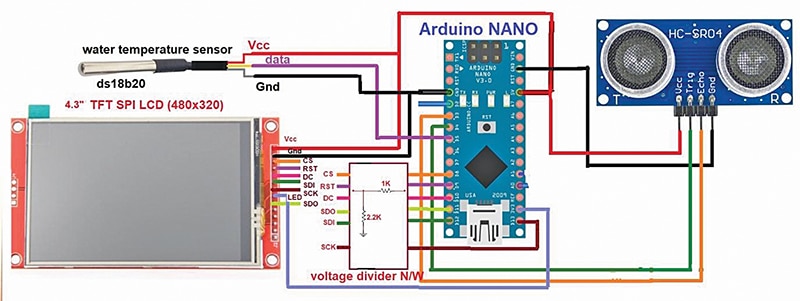
The TRIG and ECHO pins of the ultrasonic sensor connect to D4 and D3, respectively, to measure distance by calculating the time between pulse transmission and echo reception. The TFT display connects through SPI lines: SCK to D13, SDI to D12, SDO to D11, DC to D10, RST to D9, and CS to D8. Resistors R1 through R12 ensure the safe operation of the TFT module.

The Arduino is powered via the 5V rail, with a common ground across all modules. The HC-SR04 measures the distance to the water surface to compute the level, while the DS18B20 provides temperature data. The Arduino processes both and displays them graphically, using tank animations and bar graphs. The resistors protect components during operation.