

This design simplifies setup with automatic wireless node detection, and offers remote access for alarm testing, battery monitoring, and alert receiving, providing peace of mind and convenience.
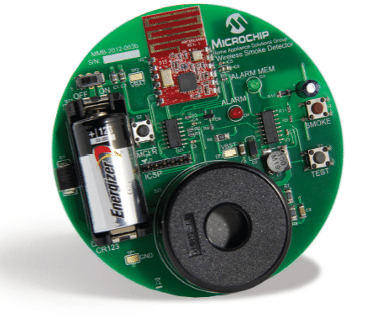
The Reference Design for a Wireless Smoke Detector serves as an essential blueprint for developing an interconnected alarm system, crucial for early fire detection and safe evacuation. With the potential for fires to escalate within minutes, the significance of early warnings cannot be overstressed. Traditional smoke alarms may not be audible throughout the entire home, especially if the fire originates from a remote location. This design addresses this issue by employing interconnected alarms, ensuring widespread coverage and enhancing the likelihood of hearing an alarm irrespective of the fire’s location. Additionally, it features the capability to send wireless notifications directly to emergency services, streamlining the alert process.
Central to this design is the integration of Microchip’s technology, including the low-power PIC16LF1825 nanoWatt XLP 8-bit PIC® Microcontroller and the RE46C190 Photoelectric Smoke Detector IC, which together facilitate a comprehensive and efficient photoelectric smoke detection system with minimal external components. Communication is handled by the MRF89XAM8A Sub-GHz wireless module, enabling effective alarm transmission. The entire system is powered by a single CR123 3V battery, emphasizing power efficiency through low-power sleep modes and a power consumption of merely 50 nA in sleep mode by the microcontroller, further reduced to 0.5 μA during Low-Power Watchdog Timer operation.
This design not only assures prompt alarm activation across the network during an incident but also simplifies the installation process via automatic wireless node detection. It features remote access for alarm testing, battery voltage monitoring, and receiving alerts, ensuring user convenience and safety. The RF Module’s compliance with certifications in key markets globally highlights its reliability and adaptability.
Microchip Technologies provides a complete package for this reference design, including a Design Guide, Bill of Materials, schematics, Gerber files, and PCB layout, offering a comprehensive resource for developing a Wireless Smoke Detector as part of the Connected Home platform. For more information, click here.