




A car’s advanced driver assistance system (ADAS) does not fail outright, but it can become confused in complex situations. That reality is prompting the industry to rethink how these systems can deliver greater reliability under real-world driving conditions.
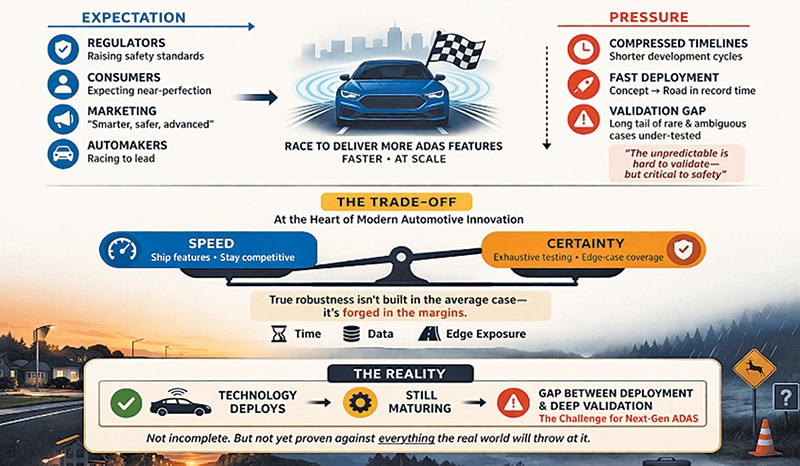
Consider a hypothetical scenario in which a driver is operating a vehicle equipped with ADAS technology. The technology extends perception, accelerates reaction times, and enhances driving safety. Yet, under certain conditions, the system may respond in ways that do not fully align with the surrounding environment: a shadow across the road is read as an obstacle, and the car brakes hard for nothing.

These are not isolated anomalies. They reflect a broader reality: although ADAS technology has advanced significantly, limitations in reliability still remain. The real question is not whether ADAS works, or even how well it works, but how it performs when perception becomes difficult. That is where the gap between expectation and execution emerges.
Regulatory pressure and market expectations
There is a growing tension shaping the evolution of ADAS, one that is not always visible from the driver’s seat, yet influences everything behind the system.
On one side, expectations are rising rapidly. Safety standards continue to tighten, and consumers now expect near-perfect performance from ADAS, driven by safety ratings, marketing narratives, and the broader promise of increasingly intelligent vehicles. At the same time, automakers are under constant pressure to introduce more advanced features faster and at scale. However, this acceleration comes with consequences.

As timelines compress, development cycles shrink. Features move from concept to deployment at increasing speed, often driven by competitive urgency. While these systems perform well in common scenarios, the depth of validation does not always keep pace. The long tail of real-world variability—the rare, ambiguous, and unpredictable—remains difficult to fully capture before deployment.
This creates a fundamental trade-off: speed versus certainty. True robustness is not built under average conditions; it is forged in the margins. This requires time, data, and exposure to edge cases that are inherently difficult to anticipate and even harder to simulate comprehensively.
As a result, a nuanced reality emerges. Many ADAS systems today are mature and, in some respects, still evolving, neither incomplete nor fully battle-tested across the entire spectrum of conditions they may eventually encounter.
It is within this gap between deployment and real-world validation that the core challenge begins to emerge.
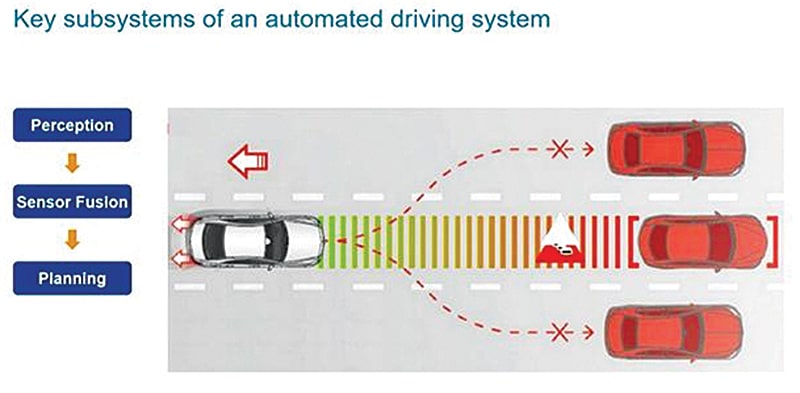
The problem statement: Why today’s systems are falling short
Consider this: a vehicle performs flawlessly in validation. Clean lanes, predictable traffic, ideal weather, everything aligns. In controlled environments, ADAS appears nearly perfect. However, the real world is far less accommodating.
On live roads, variables multiply quickly. Rain distorts sensor signals. Shadows mimic obstacles. Lane markings fade, blur, or disappear altogether. In these moments, the same system that once inspired confidence begins to behave inconsistently, not through dramatic failure, but through subtle, disconcerting deviations.
This is not a single-point failure. It is a systems-level challenge. Modern ADAS operates at the intersection of sensor inputs, algorithmic interpretation, and environmental uncertainty. Even small inconsistencies—a noisy signal or an ambiguous boundary—can cascade. Minor perception errors, when processed through probabilistic models, can lead to outcomes that feel unpredictable to the human driver.
This brings us to a critical question: How do we close this gap? The goal is no longer simply to optimise performance in controlled environments. The real challenge is designing for resilience in uncontrolled ones.
The real world is neither clean nor predictable; it is filled with edge cases that may be statistically rare but operationally decisive. In that sense, edge cases are not peripheral; they are central. They are where systems are truly tested, and where trust is either reinforced or eroded. Increasingly, they define the difference between systems that perform well in theory and those that can be relied on in practice.
| Decision framework: Should you integrate thermal imaging? |
| For ADAS R&D and product teams, the question is no longer if thermal imaging works, but where it adds measurable value. • Strong use cases for thermal integration: Consider integrating thermal imaging if your system must: – Meet advanced safety ratings (e.g., night-time AEB scenarios) – Operate reliably in low-light or high-glare environments – Address phantom braking or false positive challenges – Improve detection of vulnerable road users (VRUs) in complex conditions • When it may be optional: Thermal may be less critical for: – Entry-level ADAS with limited feature scope (basic L1/L2) – Highly cost-constrained platforms – Use cases restricted to well-lit, structured environments |
Environmental and operational challenges
The focus must therefore shift from controlled validation environments to real-world operating conditions. Vehicles do not operate on test tracks; they operate in dynamic environments where conditions are constantly changing, imperfect, and often challenging. Visibility decreases as fog reduces scene depth and contrast. Glare from low-angle sunlight can obscure critical elements within the environment. Rain streaking across the windscreen can subtly affect a camera’s field of view.
The road environment itself introduces additional complexity. The world is not always well-structured or easy to interpret. Lane markings are often ambiguous, serving more as suggestions than clear definitions. Traffic comprises pedestrians, bicycles, two-wheelers, and many other types of vehicles, each moving according to its own often-unwritten behavioural patterns.
So what happens when a system trained on structured scenarios, is presented with this kind of ambiguity? The problem becomes even more pronounced when movement is introduced. A pedestrian changes direction mid-step. A vehicle swerves unexpectedly. An object appears without prior context. These are situations that must be interpreted in real time. Many of these scenarios are also underrepresented in training datasets.
There is another, more subtle challenge: Degradation rather than outright failure. Dust on camera lenses and dirt on sensors can gradually impair performance. Partial occlusion may not be sufficient to trigger a system alert. The system may continue functioning normally while operating with a diminished view of the environment, often without informing the driver.
This raises a sharper question: Are these systems engineered for the real world or for a simplified representation of it? Technology is not proven under ideal conditions. It is proven amid noise, unpredictability, and constant deviation from the expected. That is where resilience is tested. Increasingly, that is where the underlying fragility of many ADAS architectures begins to surface, not as catastrophic failure, but as inconsistency at precisely the moments when consistency matters most.
Understanding the root causes of system failures
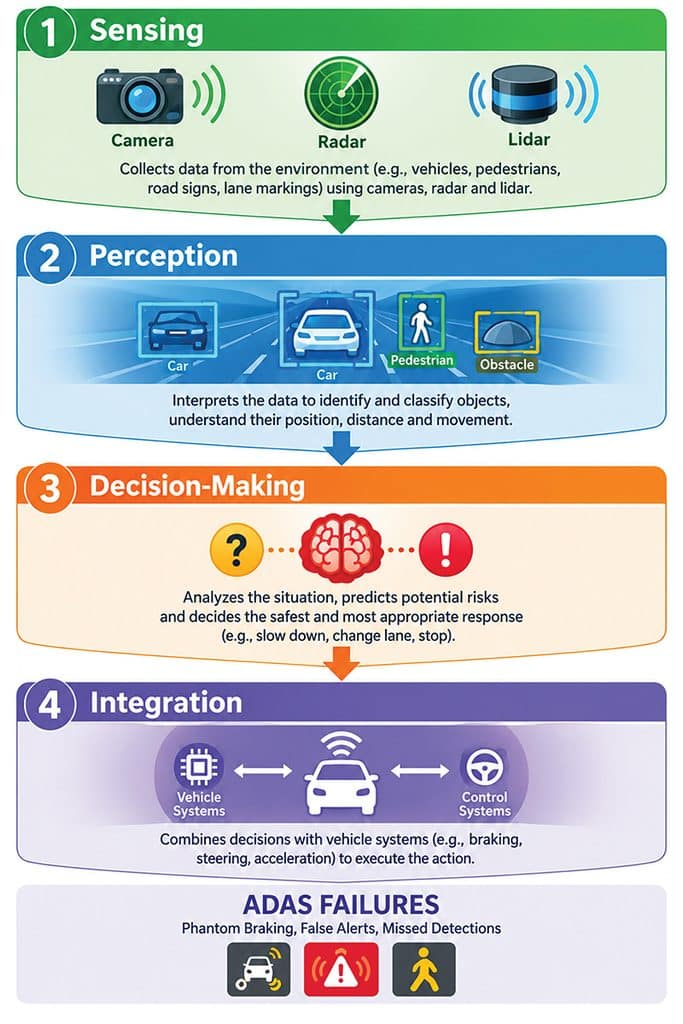
To understand the challenge, it is important to recognise that ADAS failures rarely result from a single point of failure. They are systemic, layered, and often unfold as a chain reaction.
The first layer is hardware sensing. Cameras, radar, and lidar each provide distinct advantages while carrying inherent limitations. Cameras struggle with glare and poor visibility. Radar can misinterpret reflections. Lidar, while highly precise, is not immune to environmental noise. These are not failures in isolation; they are constraints. However, when distorted inputs enter the system, they influence everything that follows.
The next layer is perception, the system’s version of ‘seeing.’ Under ideal conditions, perception is remarkably precise. However, the real world does not always present clean inputs. A shadow stretching across the road may mimic an obstacle. An object may appear only partially, obscured or outside the camera’s field of view. In these situations, perception becomes probabilistic rather than definitive. The system is no longer certain.
That uncertainty does not remain contained; it propagates downstream into decision-making. Algorithms are designed to resolve ambiguity, but only within the boundaries of their training. In clear scenarios, responses are immediate and accurate. In edge cases, however, the system may hesitate, misclassify objects, make incorrect judgements, or overcorrect. A small degree of uncertainty at the perception layer can translate into a tangible action at the vehicle level.
The final layer is integration, where all subsystems converge. ADAS is not a single system; it is a network of interconnected subsystems expected to operate in synchronisation. When they align, performance appears seamless. When they do not, inconsistencies emerge. A camera may flag uncertainty while radar reports confidence. The algorithm must reconcile that conflict in real time. Sometimes it succeeds; sometimes it does not.
This is where visible symptoms such as phantom braking, false alerts, and missed detections begin to appear. These outcomes are not random. They are the result of interconnected layers of sensing, perception, decision-making, and integration, each contributing a degree of uncertainty that can compound under adverse conditions.
The takeaway is not that ADAS is unreliable. Rather, its reliability is inherently systemic. Recognising where these systems intersect and occasionally misalign is essential to understanding how the technology will continue to evolve.
| From insight to action: Designing for what matters most |
| To move forward, ADAS teams should align around a few core principles: • Design for edge cases, not just averages • Build sensor stacks that are complementary, not redundant • Prioritise confidence and consistency over isolated accuracy gains • Continuously validate against real-world variability Within this framework, the role of thermal imaging becomes clear. It is not about replacing existing sensors but about strengthening the system where it is most vulnerable. |
Limitations of conventional design approaches
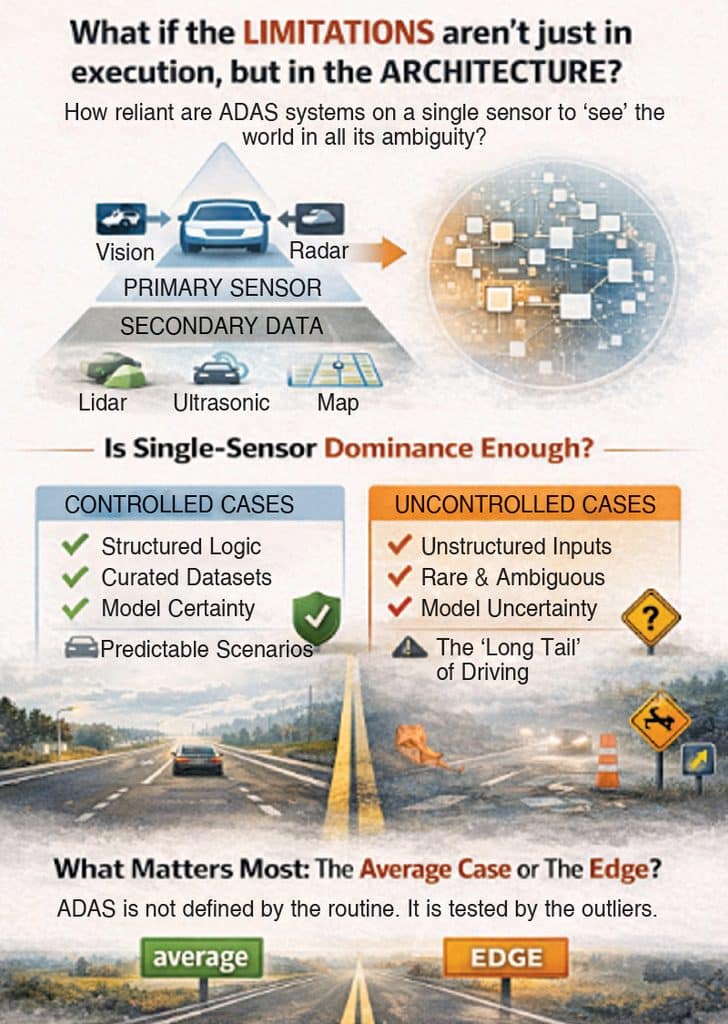
Now take it a step further and question the foundation itself: What if the limitations aren’t just in execution, but in the architecture?
For years, many ADAS designs have relied on a dominant sensor, typically vision or radar, as the primary source of truth. In controlled environments, that approach is efficient and effective. However, real-world conditions often expose the limitations of relying too heavily on a single source of information.
When a primary sensor encounters uncertainty, system confidence can erode rapidly. A camera operating in low-light conditions or facing severe glare may struggle to maintain clarity. Radar operating in dense or irregular environments may generate ambiguous reflections. In these moments, fallback mechanisms are not always as robust as they appear. True redundancy—the ability to cross-validate, reinterpret, and adapt dynamically—can be thinner than expected.
Even when multiple data streams are available, interpretation becomes the next challenge. Many ADAS platforms continue to depend on structured logic or AI models trained on finite, curated datasets. Within those boundaries, performance is impressive. Outside them, performance becomes conditional.
This is where the long tail of driving scenarios becomes significant. Construction zones with irregular lane markings, partially visible objects, unexpected road debris, and unusual traffic behaviours frequently fall outside standard training distributions. These situations are rare, but they are precisely the circumstances in which variability exceeds training data and where system robustness is tested most rigorously.
This raises a fundamental question: Can a system truly be considered reliable if it is optimised primarily for the most common events?
This is where traditional architectures are beginning to reveal their limitations: not in predictable scenarios but in unpredictable ones. The challenge no longer lies in handling routine situations effectively. It lies in managing situations that systems are only beginning to encounter and understand.
As the industry moves closer to autonomy, it is becoming increasingly clear that optimising for average conditions is no longer sufficient. Future ADAS systems must be engineered to handle edge cases with the same level of confidence and reliability as routine driving scenarios.
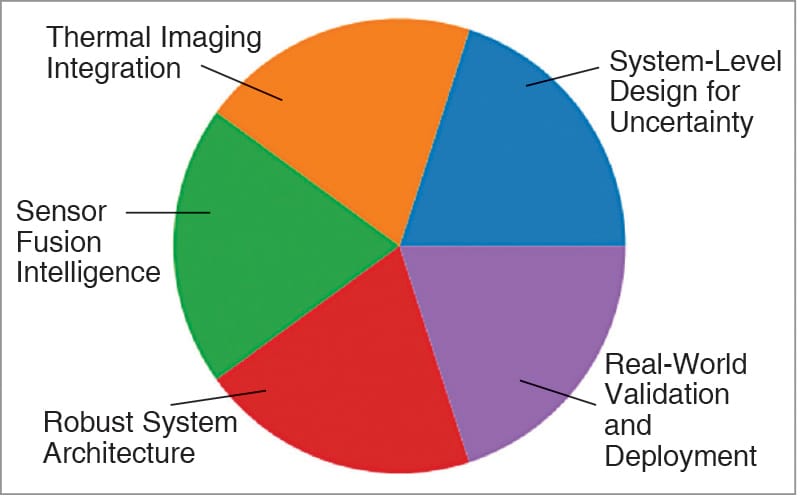
The solutions: A system-level rethink
The path forward is not about making incremental adjustments to existing systems. It requires rethinking the underlying foundations of ADAS design.
Moving beyond legacy thinking: Designing for uncertainty, not just performance
Improving ADAS reliability is not about incrementally refining individual components; it requires a shift towards system-level design that anticipates uncertainty. Traditional approaches optimise for average conditions. Real-world driving, however, is defined by edge cases, low visibility, ambiguous objects, and conflicting sensor inputs. Next-generation ADAS systems must therefore:
- Assume imperfect perception as the norm
- Prioritise robustness over peak-case accuracy
- Treat sensor diversity as a core design principle rather than an enhancement
This is where expanding beyond conventional sensing modalities becomes critical. This is the perfect point where thermal imaging fits in the ADAS stack.
Thermal imaging introduces a fundamentally different sensing modality by detecting heat signatures rather than reflected light. This makes it uniquely effective in situations where traditional sensors struggle. Key functional advantages:
- Low-light and night performance: Detects pedestrians, cyclists, and animals beyond headlight range, where cameras degrade significantly
- Glare immunity: Unaffected by sunlight or oncoming headlights—common triggers for perception errors
- Improved detection in partial occlusion: Heat signatures can remain distinguishable even when objects are visually obscured
- Reduced visual ambiguity: Minimises false positives caused by shadows, reflections, or low-contrast objects
Phantom braking is rarely the result of a random malfunction. More commonly, it arises from uncertainty or conflict within a vehicle’s perception stack. When sensors deliver ambiguous or contradictory inputs, the system often defaults to caution, triggering unnecessary braking events. Thermal imaging can play a strategic role in mitigating this issue. By introducing an orthogonal layer of perception, thermal sensing enables cross-validation alongside conventional vision systems and provides an additional means of interpreting the environment. In complex or ambiguous situations, thermal sensing can help distinguish genuine obstacles from false positives. The result is a more balanced perception framework that reduces the likelihood of misclassification and, consequently, minimises phantom braking events.
Sensor fusion as a decision engine, not just data aggregation
Sensor fusion is often framed as merely combining inputs. In reality, its effectiveness is defined by how intelligently a system resolves conflict between those inputs. A modern fusion stack must go beyond aggregation, assigning confidence scores to each sensor stream, arbitrating contextually when inputs diverge, and prioritising complementary modalities over mere redundancy. It is not about having more data; it is about knowing which data to trust, and when.
This is where thermal imaging further strengthens the perception stack. Cameras provide semantic understanding. Radar measures distance and velocity. Lidar maps geometry and structure. Thermal sensing contributes a different layer of information by detecting heat signatures. This distinction is important because it introduces a layer of awareness that remains resilient when visibility deteriorates or conventional cues become unreliable.
In practice, thermal sensing delivers particular value during periods of low visual confidence, in validating edge cases, and in reducing false positives, especially within systems such as automatic emergency braking (AEB), where misinterpretation can trigger unnecessary intervention. The result is not only enhanced perception but also more consistent and dependable decision-making under uncertainty.
Thermal imaging is not, however, a plug-and-play upgrade. Its integration introduces additional design considerations. Cost implications must be balanced against measurable safety benefits. System complexity increases, requiring careful calibration and alignment with existing sensors. Additional data streams increase computational and synchronisation demands. Sensor placement also becomes critical, as field of view and environmental exposure directly affect performance.
The objective is not replacement but reinforcement. Thermal imaging is most effective when deployed strategically to strengthen vulnerable areas of the perception stack, improving both system capability and confidence.
System architecture: Enabling real-time, reliable decisions
Even the most advanced sensors remain constrained by the intelligence and architecture responsible for processing their outputs. As ADAS evolves, the primary bottleneck is no longer perception alone; it is throughput, timing, and resilience.
Next-generation systems must be capable of handling high-bandwidth, multi-sensor data streams without compromise while maintaining ultra-low latency for decisions that must be made within milliseconds. Equally important, they must remain operational under partial system degradation, preventing a single failure from cascading into a broader loss of functionality.
The integration of thermal imaging further reinforces these requirements. It necessitates precise time synchronisation across sensing modalities to fuse disparate data into a coherent, real-time understanding of the environment. It requires scalable computing platforms capable of supporting increasingly sophisticated fusion algorithms without introducing delays. It also highlights the need for flexible, forward-compatible architectures designed to accommodate future sensing modalities as they emerge.
In this context, performance is no longer determined by individual components. It is determined by the system’s ability to orchestrate those components seamlessly, synchronously, and reliably under all operating conditions.
From development to deployment: Closing the real-world gap
One of the defining challenges in ADAS development is bridging the gap between theoretical performance and real-world reliability. It is not enough for systems to perform well in simulations or controlled validation environments. They must demonstrate reliability amid the unpredictability of everyday driving.
Achieving this requires a development pipeline that combines high-fidelity simulation with real-world edge-case data, rigorously evaluates performance under low-light and adverse-weather conditions, and continuously improves through field data delivered via over-the-air updates.
Thermal imaging acts as a force multiplier within this process. By extending the range of detectable scenarios, particularly in situations where conventional sensors struggle, it enriches validation datasets with cases that might otherwise remain underrepresented.
More importantly, thermal sensing introduces an additional layer of ground truth in ambiguous environments, helping engineers better understand what the system is actually perceiving versus what it assumes it is perceiving.
The result is a more dynamic feedback loop in which real-world complexity becomes not merely a challenge to overcome but a valuable source of learning. Insights gathered from deployment continuously feed back into development, strengthening robustness, refining models, and bringing performance closer to the realities of the road.
The road ahead: A shift in mindset
As ADAS continues to evolve, success will no longer be measured by the number of features a vehicle offers. Instead, it will be measured by how consistently those features perform under the most challenging operating conditions. For ADAS research and development teams, this represents a fundamental shift in focus—from adding capabilities to ensuring dependable behaviour, from optimising individual components to engineering system-level resilience, and from reacting to failures to proactively designing systems that anticipate them.
Several industry trends are already shaping this transition:
- AI trained on diverse, long-tail datasets. Expanding beyond common scenarios to include rare and ambiguous conditions
- Real-time, edge-based processing. Enabling faster, context-aware decisions directly within the vehicle
- Standardised safety and validation frameworks. Increasing emphasis on performance in low-light, adverse weather, and edge cases
- Deeper cross-domain integration. Sensors, software, and compute platforms designed as a unified system, not separate layers
Even as ADAS advances, one reality remains unchanged: no single sensor can address the full complexity of real-world driving.
Thermal imaging is not merely an add-on. It is a strategic sensing layer that addresses persistent perception gaps. Where cameras struggle in low light and glare, radar lacks semantic understanding, and lidar faces cost and environmental constraints, thermal sensing provides consistent detection independent of lighting conditions, improves the identification of vulnerable road users at night, and contributes an additional validation layer for critical safety decisions.
This becomes particularly relevant in challenges such as phantom braking, where the underlying issue is not simply misdetection but uncertainty. By reducing ambiguity, thermal sensing enables more stable classification, fewer false positives, and greater confidence in ADAS responses.
The broader shift is clear: moving from reacting to failures towards designing systems that anticipate them. What may appear to be isolated issues often reflect deeper limitations across perception, decision-making, and integration. Addressing these challenges requires a holistic engineering approach in which sensing, computing, software, and algorithms work together to manage uncertainty rather than avoid it.
Ultimately, the most reliable systems will not simply see more; they will understand their environment with greater certainty.
By: Akanksha Sondhi Gaur is Senior Technology Journalist at EFY with a German patent to her credit. She has seven years of industrial and academic experience, and has penned several research papers.