




Porous 3D-printed feet combined with reinforcement learning improve quadruped robot efficiency by storing and releasing elastic energy, reducing battery consumption while enhancing stability across different walking speeds.
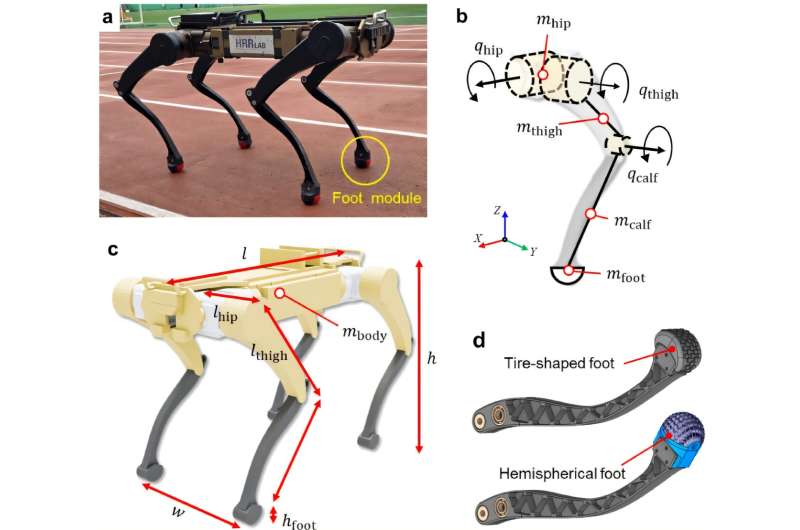
A research team at Seoul National University of Science and Technology has developed porous 3D-printed feet that enable quadruped robots to walk more efficiently by reducing energy losses during foot-ground contact. By combining advanced mechanical design with reinforcement learning (RL), the approach lowers battery power consumption while maintaining stable locomotion, potentially extending the operating time of robots used for industrial inspection, logistics, agriculture, and search-and-rescue applications.
Conventional quadruped robots typically use rigid feet to simplify motion control. However, rigid contacts dissipate impact energy every time the robot’s feet strike the ground, increasing actuator workload and shortening battery life. The researchers addressed this limitation by replacing solid feet with lightweight porous structures based on triply periodic minimal surface (TPMS) geometries, which behave like passive springs that absorb impact and return part of the stored energy during the next step.
The team designed hemispherical TPMS foot modules using additive manufacturing and evaluated several internal lattice configurations. Compression testing showed that a diamond-type TPMS with approximately 60 per cent relative density offered the best balance of compliance, energy absorption and low hysteresis losses, allowing the feet to deform under load while efficiently recovering their shape.
To exploit these mechanical properties, the researchers incorporated a TPMS dynamics model into a morphology-aware deep reinforcement learning framework. Instead of treating the feet as rigid bodies, the controller considered the elastic energy stored and released by the porous structures while learning locomotion policies. An energy-phase reward function synchronised actuator output with the deformation characteristics of the compliant feet, enabling more efficient gait generation.
Experimental validation on a quadruped robot demonstrated battery power savings ranging from 1.4 per cent to 6.2 per cent across walking speeds of 0.4 m/s to 1.0 m/s compared with conventional solid hemispherical feet. The compliant foot design also maintained stable locomotion while reducing unnecessary actuator effort, highlighting how mechanical intelligence and AI-based control can complement each other to improve robotic efficiency.
The work demonstrates that optimising both robot hardware and control algorithms together can significantly improve energy efficiency. As quadruped robots become more common in autonomous inspection, hazardous environments, and field robotics, integrating compliant, additively manufactured structures with AI-driven locomotion control could enable longer missions without increasing battery size or system complexity.
