




What would it take for a flying robot smaller than a paperclip to navigate on its own? MIT researchers have equipped one with onboard sensors and computing.
Credit: Courtesy of the researchers
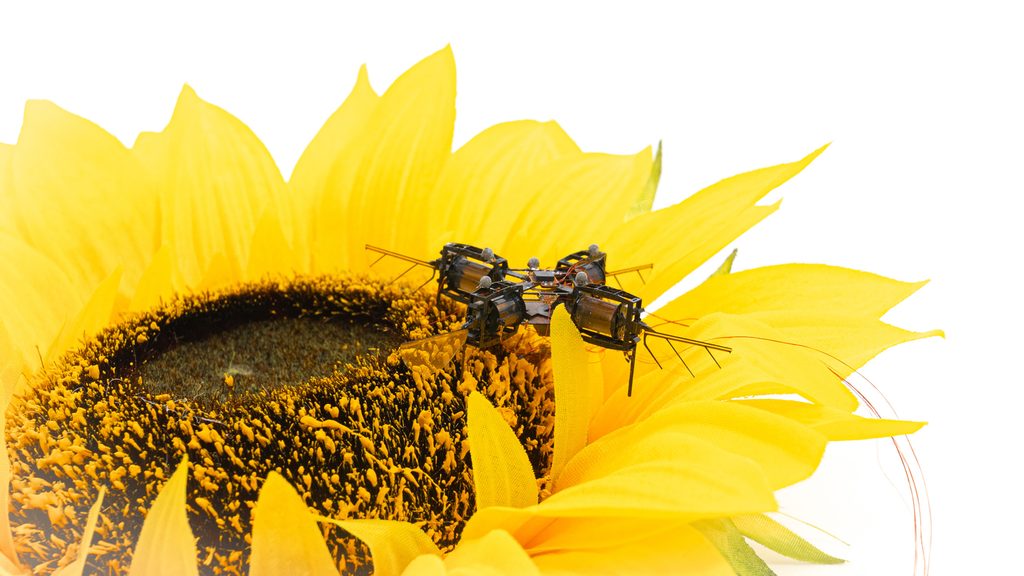
Researchers at the Massachusetts Institute of Technology (MIT) have developed a flapping-wing microrobot which can self-navigate. Unlike previous microrobots, it does not need to be monitored by an external motion capture system. It is able to both navigate and execute tricks to successfully alight on a sunflower. This is a step towards using micro aerial vehicles for example in agriculture and industry inspection.
Whilst previous microrobots were capable of fast and acrobatic flight, they could not self- navigate and had to be monitored by external cameras. The new microrobot has been fitted with a compact computer and sensing equipment. The whole package weighs a mere 244 milligrams.
To fit this in to the robot, the researchers had to modify the wing drive system. The microrobot has four flapping wings which are moved by ‘artificial muscle’ actuators. The size of these was increased by 50%. In addition, their shape was altered so that the robot could experience a 46% boost in lift generation. Despite this, the robot was still able to maintain its flight capability and so was able to support the extra equipment.
The computer is fitted with three sensors. An inertial sensor detects the robots attitude, a visual flow sensor detects horizontal motion and location, and a time of flight sensor detects altitude. Computer analysis of data from these allows the robot to analyse its own motion.
Furthermore, the researchers have also produced compute code which can enable quick analysis of data in order to minimise error in the robot’s location detection. Even though fast analyses are less accurate, this code analyses the robot’s likely location at a higher rate. The group states that this provides similar levels of location accuracy to when external cameras are used for monitoring.
The robot hovered at different heights during demonstrations, followed point-to-point trajectories and moved between plants before landing on a sunflower. The electronics consume about 6% of the robot’s total power, leaving most of its energy for wing movement.
While the robot is still externally powered at present, the researchers are endeavouring to embed both batteries and power electronics within it. They also intend to incorporate a camera so that the robot can recognise objects and avoid collisions.
If the developments succeed, such microrobots could eventually support agriculture to monitor plant health, identify pests or assist with pollination. Their small size could also make them useful for inspecting industrial spaces that are difficult for larger robots to access.
