

A programmable semiconductor adapts to changing data speeds, cutting prediction errors sharply while supporting faster, more efficient real-time AI processing across devices and practical applications.
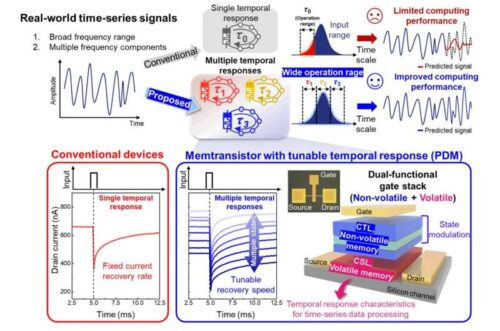
The Korea Advanced Institute of Science and Technology (KAIST) has developed a programmable dynamic memtransistor (PDM), a semiconductor device designed to process time-varying data with adaptable response characteristics. In reported experiments, the technology reduced prediction errors by up to 40-fold compared with conventional fixed-response semiconductor devices.
The research addresses a limitation in conventional semiconductor hardware, whose response speeds are generally fixed after fabrication. As computers and smartphones handle data that changes over time, processing these signals can create heavier computational workloads and higher power consumption.
The PDM uses a dual-layer structure inside the transistor. One layer stores charge and processes incoming data, while an electron-trapping layer controls the device’s response speed in a non-volatile manner. This allows the semiconductor to retain multiple response states and adjust its behaviour to incoming signals.
Researchers tuned the current recovery time across an approximately five-fold range and the characteristic frequency across more than ten-fold. This flexibility enables the device to respond to signals containing both fast and slow changes.
The team also fabricated an integrated PDM array for parallel time-series signal processing. Tests involving time-series prediction showed that adaptable response characteristics could substantially reduce errors, with improvements reaching up to 40-fold when fast and slow data changes were mixed.
The technology is intended for real-time artificial intelligence applications where data patterns can vary rapidly. According to the research team, the approach could improve processing in autonomous vehicles, robots and wearable devices while reducing energy consumption. The research was published in Nature Communications.