




What if walking could be relearned through repeated robotic movement? An AI-powered exoskeleton is helping patients retrain their gait during rehabilitation.
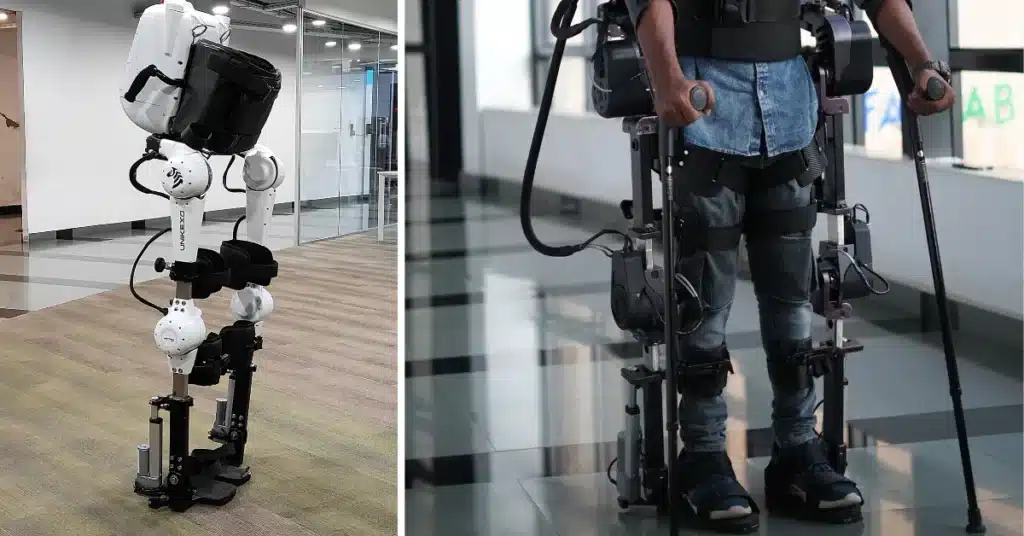
A Kochi-based startup, Astrek Innovations has developed a lower-limb robotic exoskeleton that assists patients with walking movements during rehabilitation. The device straps around the user’s hips and legs, uses motors to drive leg movement, and applies machine learning to support the patient’s gait pattern.
The technology is designed for robotic-assisted gait training, where repeated walking movements are used to help retrain the nervous system following conditions such as stroke and spinal cord injury. Rehabilitation specialists say repeated gait cycles can help the brain establish new neural pathways associated with movement.
The algorithms behind the system were developed using six years of data on how healthy people sit, stand and walk. This data was used to train the system to anticipate and support movement in a manner intended to feel more natural.
The mechanical design also reduces the reliance on upper-body strength required by conventional callipers. Instead of requiring a user to manually move their legs using their arms and torso, the powered exoskeleton drives the lower-limb movement through its motors.
The system has been tested with people recovering from spinal cord injuries. In one case, a user with paraplegia who had relied on callipers for years was able to experience motor-assisted leg movement through the exoskeleton.
Beyond gait retraining, the system can provide supported weight-bearing, balance training and repeated lower-limb movement for patients with complete spinal cord injuries. For stroke patients, the repeated gait cycles are intended to support motor retraining.
However, the exoskeleton is not intended to replace therapists. Patients’ neurological conditions can change during rehabilitation, requiring treatment to be adjusted accordingly.
“A preset robot cannot do the same job as a therapist,” says Dr Remya Mathew, consultant in physical medicine and rehabilitation at Rajagiri Hospital. “Each day, the patient’s neurological condition changes slightly. A therapist continuously grades and modifies the therapy,” she added.

