




A dual-core RISC-V flight controller integrates redundant sensing, real-time control, and onboard AI inference for fixed-wing aircraft, multirotor drones, and unmanned surface vessels.
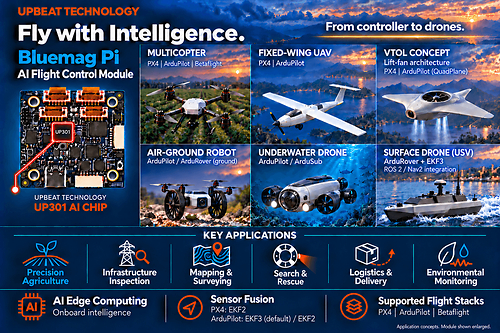
Upbeat Technology’s Bluemag Pi is a sensor-integrated AI flight controller designed to combine flight-critical control and onboard AI processing on a single platform. The board is based on the UP301 system-on-chip (SoC), which integrates SiFive’s E3 and E2 RISC-V processor cores in a dual-core architecture. The design targets long-endurance fixed-wing aircraft, commercial multirotor drones, and unmanned surface vessels where deterministic control and edge intelligence need to operate within tight power constraints.
Its architecture separates time-critical flight-control workloads from communication, navigation, and system-management tasks. This allows flight operations to remain responsive while other computing functions, including AI inference, run concurrently. The controller also provides RAM, nonvolatile storage, hardware floating-point support, timers, direct memory access (DMA), and interrupt resources for advanced autonomous-flight workloads.
Bluemag Pi runs the Apache NuttX real-time operating system and supports open-source flight-control frameworks including PX4, ArduPilot, and Betaflight. This makes the platform suitable for developers building customised flight-control algorithms rather than relying solely on a fixed software environment.
The key features are:
- Dual independent processor cores for workload isolation
- Redundant sensor architecture for fault detection
- Integrated four-in-one motor-control stage
- Continuous onboard flight-data recording
- Custom carrier-board development using UP301
For sensing and navigation, the board incorporates two independent IMUs, a barometer, and dual GNSS receivers. Sensor-fusion software cross-checks the measurements to improve the reliability of altitude, attitude, and velocity estimation. This redundant sensing architecture is particularly useful for UAV applications where sensor degradation or failure can affect flight stability.
The controller also provides MAVLink-based telemetry, remote-control receiver inputs, and motor-control capability through an integrated four-in-one electronic speed controller (ESC). Expansion interfaces allow additional sensors and peripherals to be connected, while onboard storage enables continuous flight-data logging for diagnostics, tuning, and post-flight analysis.
Bluemag Pi can be used for applications such as autonomous inspection drones, agricultural UAVs, logistics platforms, defence systems, and other unmanned vehicles requiring local decision-making. Developers can purchase the standard board for secondary development or use the UP301 IC directly when designing proprietary carrier boards. With appropriate hardware and firmware integration, the platform supports manual, stabilised, altitude-hold, position-hold, mission, return-to-home, and autonomous flight modes.
