





AI tools help automate chip design, testing, and heat analysis, cutting development time and reducing the need for manual work.
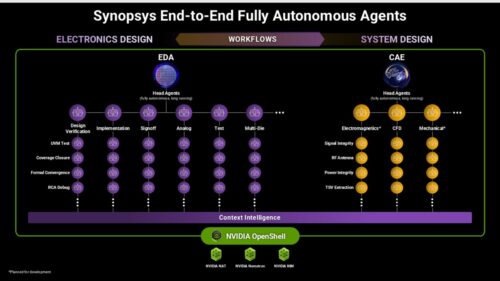
Synopsys has introduced a new set of AI-powered engineering tools that automate chip design, verification, and simulation workflows. The new capabilities were developed with NVIDIA and are designed to reduce manual engineering work across electronic design automation (EDA) and computer-aided engineering (CAE).
The biggest addition is a fully autonomous design verification (DV) workflow. Instead of relying on engineers to manage individual verification tasks, the system uses an AI orchestrator that analyzes design specifications, test repositories, and user inputs, then coordinates multiple AI agents to generate test plans, debug designs, and achieve coverage closure. According to Synopsys, the workflow can reduce verification time from weeks to hours, providing up to 50× faster validated RTL and up to 20% higher coverage.
The company also introduced AI-driven workflows for analog and mixed-signal (AMS) design. Engineers can describe design requirements in natural language, after which AI agents perform layout generation, SPICE simulation, implementation, optimization, and verification. Synopsys says the approach can improve engineering productivity by up to three times.
Another addition is an autonomous thermal analysis workflow for electronics cooling. Built using Ansys Icepak simulation software, NVIDIA Agent Toolkit, CUDA-X libraries, and PyAEDT, the workflow automatically sets up simulations, runs analyses, and processes results without requiring engineers to perform each step manually.
Alongside these AI agents, Synopsys expanded GPU acceleration across its engineering software portfolio. PrimeSim SPICE circuit simulations now run up to 18 times faster on NVIDIA GPUs. QuantumATK delivers up to 50× faster quantum chemistry simulations and up to 200× faster machine learning-based force field simulations. Ansys Lumerical FDTD electromagnetic simulations also achieve up to 10× higher performance on NVIDIA GPUs compared with CPUs.
The AI capabilities run on NVIDIA’s accelerated computing platform using NVIDIA Nemotron models and the OpenShell runtime. The companies say the platform enables AI agents to execute long-running engineering workflows with minimal human intervention.
Click here for the original announcement.
