




What can air bubbles tell an underwater robot? An AI system tracks a diver’s breathing and detects changes linked to stress and fatigue.
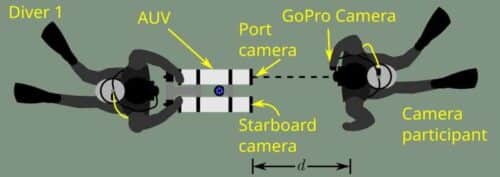
Researchers at the University of Minnesota Twin Cities have developed an AI-based underwater monitoring system that enables companion robots to estimate a diver’s breathing rate in real time by analysing exhaled air bubbles.
Scuba diving, especially in deep or challenging underwater environments, can expose divers to exhaustion, stress and breathing difficulties. The new system allows camera-equipped autonomous underwater vehicles (AUVs) to monitor a diver without requiring any wearable sensors. By tracking the frequency and size of bubbles released from the diver’s regulator, the robot can detect changes in breathing that may indicate stress, hyperventilation or fatigue.
The approach addresses a major limitation of existing underwater health monitoring methods. Wearable medical sensors often do not work reliably because thick wetsuits or drysuits prevent proper contact with the skin, while wireless communication through water is highly restricted.
To train the AI model, the researchers created a large dataset of underwater videos and audio recordings collected from Lake Superior, Square Lake in Minnesota, and the Caribbean Sea near Barbados. Since underwater visibility is often poor, the team developed a “fuzzy labeling” method in which thousands of images were manually labelled using synchronized audio recordings of regulator exhalations. This helped the AI accurately identify breathing events even in murky water and under different environmental conditions.
The system was tested during open-water dives in the Caribbean using autonomous underwater vehicles. The researchers also developed a communication system called HREyes, which allows the robot to inform divers about their breathing status. It classifies breathing as below normal (less than 14 breaths per minute), normal (14–20 breaths per minute) or above normal (more than 20 breaths per minute). By converting visual observations into respiration rate, the robot can identify when a diver may be under physical stress.
The researchers plan to further improve the system by combining breathing-rate analysis with diver movement tracking. They believe that merging these two sets of information will enable the robot to build a more complete wellness profile, improving safety during underwater exploration, scientific missions and rescue operations.
