

AI-powered wearables are evolving beyond fitness tracking into personal assistants capable of managing daily tasks, analysing conversations and offering personalised guidance, intensifying concerns over data privacy.
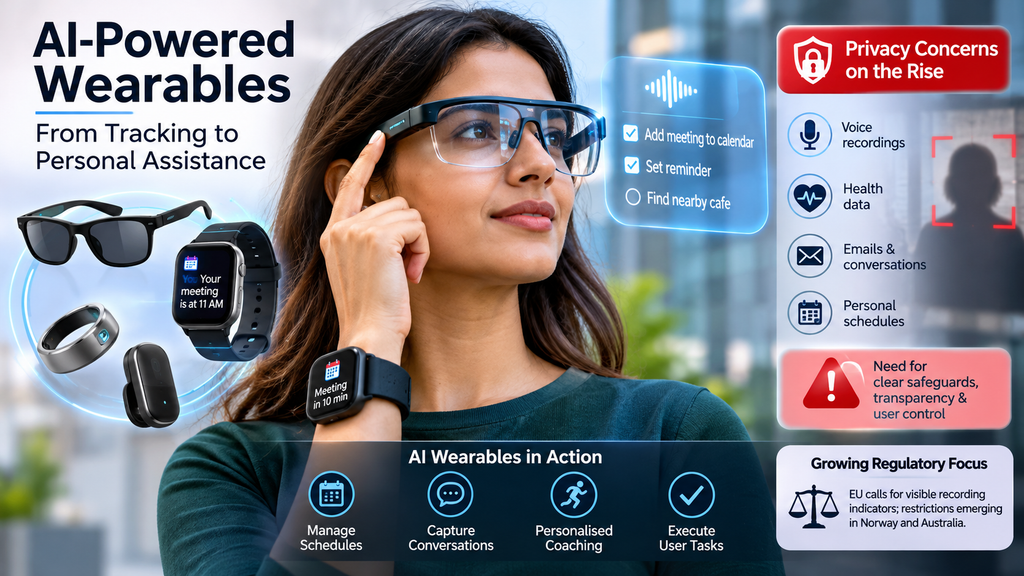
Artificial intelligence (AI) is transforming wearable electronics from personal tracking devices into intelligent assistants capable of performing everyday tasks. Smart glasses, rings, watches and clip-on devices are increasingly integrating AI capabilities to manage schedules, capture conversations, provide personalised coaching and execute user instructions. However, expanding access to personal data is raising concerns about privacy, surveillance and user consent, according to a report by GlobalData.

The report, titled AI is Moving Wearables from Personal Tracking to Personal Assistance, Raising the Stakes for Privacy, highlights how AI integration is changing the functionality of body-worn electronics. Unlike conventional wearables that primarily monitor fitness, sleep and health parameters, newer devices can interact with digital services and perform tasks on behalf of users.
Companies including Apple, Google and Samsung are expanding AI assistance across smartphones, smartwatches and earbuds. Meta is developing a broader personalised AI ecosystem around its smart glasses through Muse, its personal AI agent. Meanwhile, Oura and WHOOP are focusing on AI-driven health insights and personalised guidance.
AI-first devices are also entering the market. Amazon’s Bee, a wrist-worn or clip-on device, captures conversations and converts information into reminders, supporting everyday organisation. Such devices demonstrate how microphones, connected applications and AI processing can enable hands-free digital assistance.

However, these capabilities require access to increasingly sensitive information, including voice recordings, health data, emails, calendars and private conversations. Smart glasses present additional challenges because people nearby may be recorded without their knowledge. Meta has made the recording indicator on its smart glasses more tamper-resistant following consumer concerns, but privacy safeguards remain a challenge.
Regulatory scrutiny is also increasing. In October, the European Data Protection Board called for clearly visible recording indicators and stated that manufacturers cannot transfer their privacy responsibilities entirely to users. Restrictions and bans are also emerging in countries such as Norway and Australia. As AI capabilities expand across wearable electronics, manufacturers face the challenge of balancing always-available assistance with data protection, transparency and user control.