

Two cellular modules bring production-ready Android 16 to payment terminals and handheld IoT devices, simplifying the software needed to build connected products.
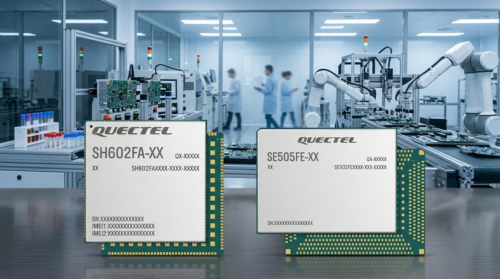
Quectel has introduced two cellular smart modules with production-ready Android 16, combining application processing, cellular connectivity and wireless interfaces in a single component. The SH602FA supports 4G LTE Category 4, while the SE505FE adds 5G Sub-6 GHz connectivity for products such as POS terminals, smart displays, industrial handhelds and service robots.
Building a payment terminal or industrial handheld around separate components normally means integrating the application processor, cellular modem and RF circuitry individually. A smart module brings these functions together, allowing product makers to design a carrier board around an integrated platform instead of developing the cellular radio and associated RF section from the ground up. This can reduce some of the specialised hardware and certification work involved in developing a connected product.
The 4G option uses the MediaTek MT8786, combining two Arm Cortex-A75 cores at 2.0 GHz with six Cortex-A55 cores at 1.8 GHz and an Arm Mali-G52 2EEMC2 GPU. The SH602FA comes with 4 GB of LPDDR4X memory and 64 GB of eMMC storage, with 2 GB and 32 GB configurations also available. Its LTE Cat 4 modem supports up to 150 Mbps downlink and 50 Mbps uplink, with 3G WCDMA and 2G GSM fallback and 2×2 downlink MIMO. The module provides a four-lane MIPI-DSI interface for displays up to 1080 × 2520 pixels at 60 frames per second, camera support up to 25 megapixels, dual-band Wi-Fi 5, Bluetooth 5.0 and 47 GPIOs. It measures 40.5 × 40.5 × 2.8 mm in an LCC package and weighs 10.39 grams.
The 5G variant uses the MediaTek MT8863T, with two Cortex-A76 cores running at 2.4 GHz and six Cortex-A55 cores at 2.0 GHz, alongside an IMG GE8300 GPU at 660 MHz. Its Sub-6 GHz 5G modem supports up to 3.27 Gbps downlink and 1.25 Gbps uplink with 4×4 downlink MIMO. It also supports displays at up to 120 frames per second, three four-lane camera interfaces for sensors up to 32 megapixels, USB 3.1, Bluetooth 5.2, 181 GPIOs and five analogue-to-digital converters. The SE505FE measures 42.5 × 56.5 × 2.95 mm in an LGA package. Both modules support dual-SIM dual-standby and multi-constellation positioning across GPS, GLONASS, BeiDou, Galileo and QZSS, with an operating temperature range of -35°C to +75°C.
The main software advantage comes from the Android 16 platform supplied with both modules. Developers can use standard Android APIs and interface tools rather than building a complete operating environment themselves. Quectel also provides resources including Android board support packages (BSPs), SDKs, firmware images, QFlash flashing tools, USB drivers and Android Debug Bridge (ADB) support. Some development materials may require registration or a support request, so product teams should confirm access to the required software and documentation before starting development.
Quectel has not disclosed pricing for either module. The SH602FA is offered in regional variants, including a configuration listed for India, while the SE505FE is available in variants including the SE505FE-EM. For Indian 5G designs, the publicly available launch information does not provide enough detail to confirm support for key bands such as n28 at 700 MHz and n78 in the 3.3–3.8 GHz range. Indian designers should therefore verify the exact supported bands with Quectel before selecting the SE505FE for a product.
India is a major market for the types of connected devices these modules target. NPCI recorded 23.20 billion UPI transactions in May 2026, while the country’s expanding digital-payment infrastructure continues to drive demand for connected payment terminals and handheld devices. Android-based payment terminals are already part of this market, making a module with a maintained Android 16 platform potentially useful for domestic manufacturers. Regulatory compliance remains an important part of deployment, with wireless equipment potentially requiring WPC Equipment Type Approval and applicable POS products also subject to requirements such as BIS registration and payment-industry certifications, depending on the product and deployment.
The bigger advantage of these modules is therefore not simply cellular connectivity. By taking on much of the Android platform and wireless software work, Quectel reduces the development burden for manufacturers building connected products. For Indian terminal makers trying to deliver certified, updatable Android devices quickly, that reduction in software work could be more valuable than squeezing additional performance from the modem.
For more information, click here.