




What if failed satellites could be serviced instead of abandoned? An Indian startup is testing the autonomy needed to approach and dock with them.
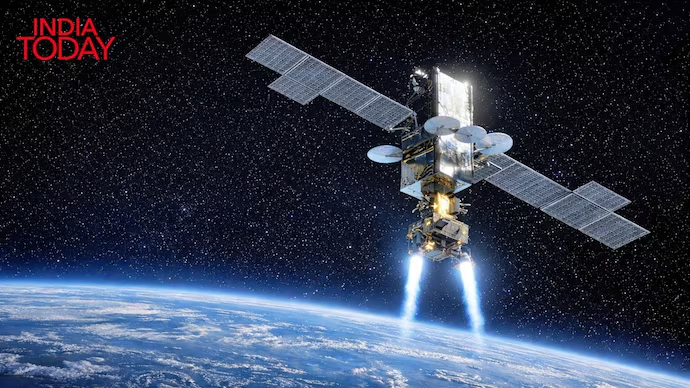
A Bengaluru-based space technology startup Aule Space has tested its relative guidance, navigation, and control (GNC) stack at Indian Space Research Organisation’s (ISRO’s) Rendezvous Simulation Laboratory (RSL), achieving Technology Readiness Level 6 (TRL-6). The Bengaluru-based space technology company is developing autonomous rendezvous, proximity operations, and docking (RPOD) technology for spacecraft that may need to approach and service satellites in orbit.
The technology could enable servicing spacecraft to approach satellites that are non-operative, inactive, or potentially tumbling. Such systems could eventually support satellite life extension, inspection, orbital manoeuvring, and debris-management operations instead of leaving failed spacecraft in orbit.
A key advantage is autonomous relative navigation, which allows the servicing spacecraft to determine the target’s position and motion without depending on conventional global positioning system (GPS). This is particularly important during close-proximity operations, where small errors in relative position, velocity, or attitude can make docking difficult.
During the ISRO demonstration, the system was tested for the final 15-metre approach to a target spacecraft. The navigation stack used cameras alone to determine relative motion, while two robotic arms at the RSL reproduced the relative movement of the chaser and target across six degrees of freedom. A solar simulator provided space-representative illumination conditions. Across multiple test runs, the system autonomously guided the chaser to the required final set point within docking tolerances.
The GNC stack forms part of a broader RPOD technology being developed for future in-orbit docking demonstrations. Aule Space is also developing autonomous docking and servicing capabilities intended to allow spacecraft to attach to existing orbital assets.
