

By embedding temperature control directly into the cell, the “all-climate” architecture removes the need for bulky external cooling or heating systems—paving the way for more reliable electronics, electric vehicles, and energy storage in harsh environments.
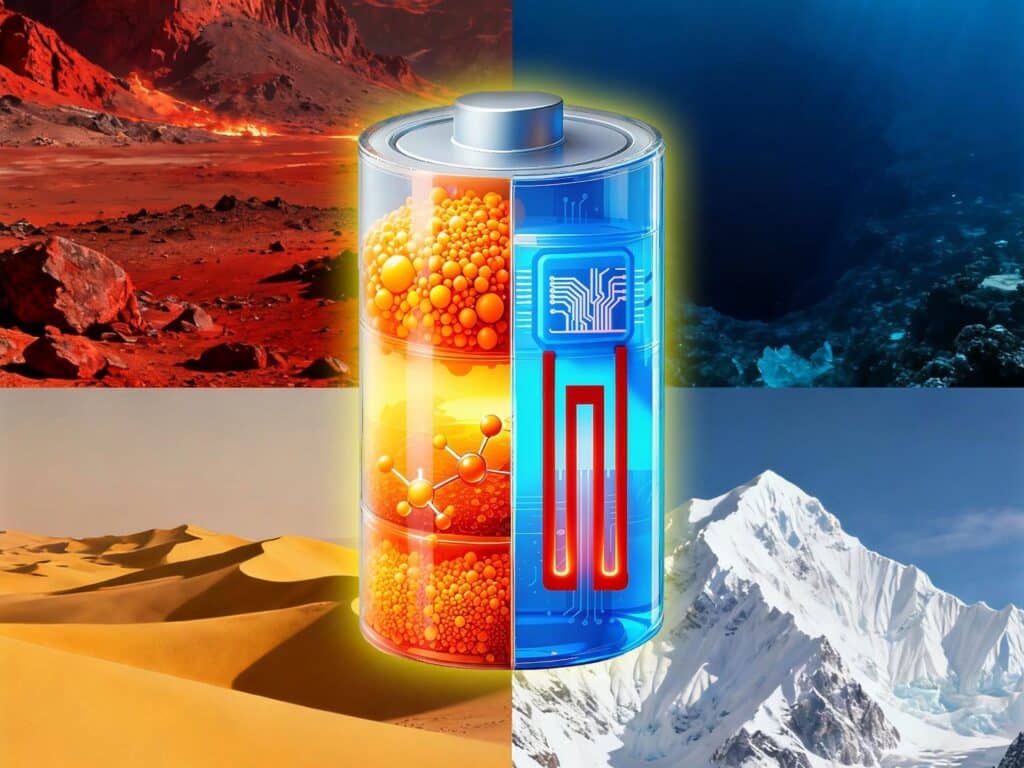
Researchers at Penn State University have unveiled a new “all-climate” lithium-ion battery design that embeds a thin internal heater and optimised materials to keep performance stable from –50 °C to 75 °C. Lithium-ion batteries today perform well in moderate conditions but struggle in extreme hot or cold environments—performance drops sharply below zero and at high temperatures they risk instability or even failure. By contrast, this new architecture, which the team published in the journal Joule, offers a path to extend usable temperature range dramatically.
The key innovation lies in combining two complementary strategies: enhancing the materials in the cell to survive hot environments, and adding a microscopic nickel-foil heater inside the battery to pre-warm it when the ambient temperature is low. The heater is only about 10 microns thick — around the size of a red blood cell — which means it adds virtually no weight or volume.
By embedding thermal management within the battery itself, the design aims to eliminate the bulky, power-hungry external cooling or heating systems currently used for batteries in, say, data centres, electric vehicles or solar installations. With fewer external components, the system reduces space requirements, cost, power consumption and maintenance burden.
In lab tests the team showed that the proposed battery could maintain stable performance across a wide temperature band from –50 to 75 °C, opening up use cases previously off-limits for conventional batteries. Looking ahead, the researchers note that further development could push the upper limit even higher (to about 85 °C) to meet demands for high-power systems like advanced drones, data centres or electric vehicles.
If scalable and affordable, this “all-climate” battery approach could reshape how energy storage is deployed in extreme environments — deserts, cold climates, satellites, remote installations — by enhancing reliability and reducing the overhead of thermal management.