

A bee-inspired decision rule could help robot swarms make faster, more reliable collective choices when conflicting or unreliable information threatens autonomous operations in uncertain environments.
Researchers at the University of Konstanz have developed a bee-inspired decision-making algorithm that helps robot swarms reach consensus more quickly, even when some information circulating through the group cannot be trusted. The study, published in Nature Communications, examines a mechanism called cross-inhibition that could make autonomous robot swarms more resilient to unreliable information.
The approach addresses a key challenge for swarms operating in disaster zones, chemical-spill response and environmental monitoring, where robots may need to decide collectively which problem to tackle and where to move next. Sharing information improves collective decisions, but inaccurate observations, faulty machines or manipulated messages can mislead an entire group.
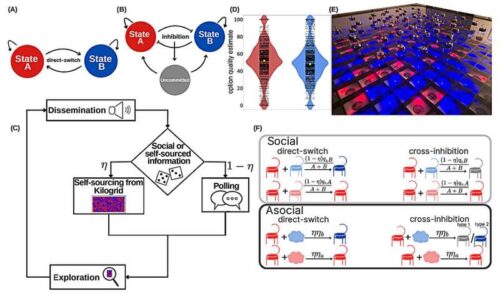
Researchers compared two ways robots respond when incoming information conflicts with their existing opinions. With direct-switch behaviour, a robot immediately abandons its current choice and adopts the new one. Although simple and computationally light, this can cause repeated changes of opinion when conflicting messages circulate.
Cross-inhibition introduces a short period of indecision. Instead of immediately copying conflicting information, the robot temporarily suppresses its current commitment before accepting new evidence. The researchers found this generally allowed swarms to reach clearer and faster decisions, including when groups became larger or had to choose among more than two alternatives.
The mechanism was inspired by honeybee colonies searching for new nesting sites. Bees supporting one location can inhibit signals advertising competing sites, helping the colony converge on a single destination.
Importantly, the study found that a moderate amount of unreliable information could sometimes improve decision accuracy by preventing the swarm from settling on a poorer option. The researchers also connect cross-inhibition with similar winner-take-all interactions found in biological systems, including neural and cellular networks.
The findings suggest biological decision-making principles could guide the design of more robust autonomous swarms, particularly where rapid decisions are needed under uncertain conditions.