After years of sluggish transport and instability, a redesigned molecular framework now alters how calcium ions move, revealing a more durable battery pathway.
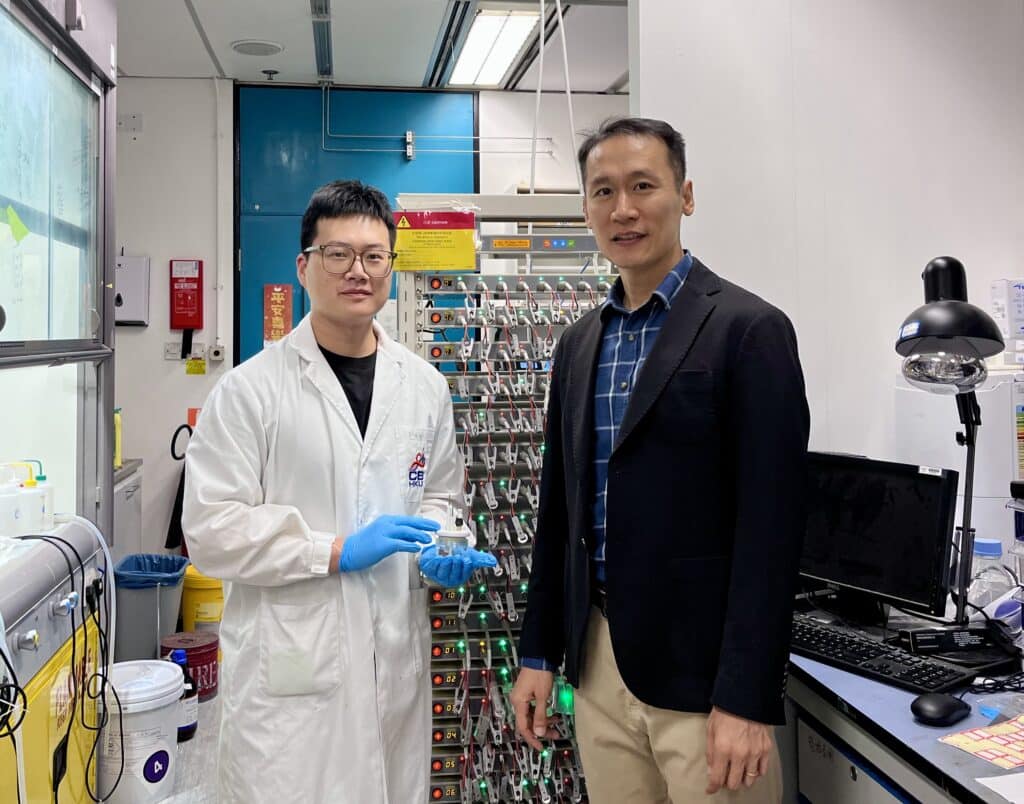
Researchers at the Hong Kong University of Science and Technology (HKUST) have developed a new calcium-ion battery (CIB) architecture that improves energy storage efficiency and long-term stability. The work, published in Advanced Science, introduces redox-active covalent organic frameworks (COFs) as quasi-solid-state electrolytes (QSSEs), addressing key technical barriers that have limited the performance of CIBs.
As demand grows for sustainable energy storage, alternatives to lithium-ion batteries are gaining attention due to concerns over resource constraints and energy density limits. Calcium-ion systems are attractive because calcium is abundant and offers an electrochemical window comparable to lithium-based technologies. However, practical deployment has been hindered by sluggish Ca²⁺ transport and poor cycling stability.
To overcome these challenges, the researchers engineered carbonyl-rich redox COFs to function as QSSEs. These materials demonstrated ionic conductivity of 0.46 mS cm⁻¹ and a Ca²⁺ transport number greater than 0.53 at room temperature. Experimental and simulation results showed that calcium ions move efficiently along aligned carbonyl groups within the ordered pores of the COF structure. This guided ion transport mechanism significantly improves charge transfer and structural stability during cycling.
Using this electrolyte design, the researchers assembled a full calcium-ion cell that achieved a reversible specific capacity of 155.9 mAh g⁻¹ at 0.15 A g⁻¹. The cell retained over 74.6% of its capacity at 1 A g⁻¹ after 1,000 cycles, demonstrating both durability and performance gains compared to earlier CIB prototypes.
The study represents a step forward in advancing calcium-ion systems as viable next-generation energy storage technologies for renewable energy integration and electrified transportation.
Prof. Yoonseob Kim from the Department of Chemical and Biological Engineering, who led this research work says, “Our research highlights the transformative potential of calcium-ion batteries as a sustainable alternative to lithium-ion technology. By leveraging the unique properties of redox covalent organic frameworks, we have taken a significant step toward realizing high-performance energy storage solutions that can meet the demands of a greener future.”