HomeElectronics NewsCan Fish And Fish-Like Robots Communicate?

Can Fish And Fish-Like Robots Communicate?

Peking University and China Agricultural University researchers have recently examined the effects of coexisting live fish and robotic fish.
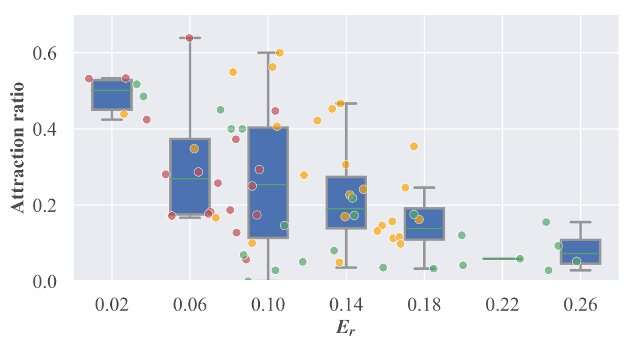
Relationship between attraction ratio and Er. The figure shows the relationship between the attraction ratio and the relative kinetic energy Er of the robotic fish when interaction occurs. It can be observed that there is a significant negative correlation between the attraction ratio and the relative kinetic energy, the Spearman rank correlation coefficient is ρ = −0.535 with a P value of p = 0.000001. This suggests that when the relative kinetic energy of robotic fish increases, the trend of fish actively approaching robotic fish is decreasing. Credit: Zhou et al

Engineers have recently developed animal-inspired robotic systems, such as four-legged robots, snakes, insects, squid, and fish. However, studies on the interactions between these robots and their biological counterparts are still limited.

- Advertisement -

Researchers at Peking University and China Agricultural University have recently studied the impact of placing live fish in the same environment as a robotic fish. During field experiments, live fish were observed following the robotic swimming fish, prompting researchers to study the underlying principles of this behavior. The team investigates fish-robot interaction to benefit robotics and biology research. Their koi-inspired robot replicated the fish’s appearance and movements for the experiments.

Based on the central pattern generator (CPG) model, the control system generates rhythm signals for the oscillations of our two-jointed system. These signals drive the caudal fin to produce an anti-Karman vortex street and achieve a body-caudal fin (BCF) motion like koi fish. This design allows the robotic fish to swim efficiently and study fish behavior. The team placed their koi fish-like robot prototypes in a tank with live fish and observed their behavior, examining the effects of the number of live fish in the tank.

According to the researchers, the most significant accomplishment of the study was the analysis of experiments on quantity and parameter variation. The extensive experimentation revealed that live fish have notably lower proactivity when alone, while the most proactive scenario is when a robotic fish interacts with two live fish. The experiments on parameter variation also indicated that live fish might respond more proactively to robotic fish with high frequency and low amplitude, or they may move together with the robotic fish at high frequency and high amplitude.

- Advertisement -

The researchers’ findings could inspire the design of more fish-like robots and prompt further studies on animal-robot interactions. This could provide insights into the social behavior of animals and their response to robots in their natural habitats. The researchers believe that flexible materials like dielectric elastomers are a promising avenue for improving robotic fish by creating silent and vibration-free propulsion technology.

Reference : Ziye Zhou et al, Proactivity of fish and leadership of self-propelled robotic fish during interaction, Bioinspiration & Biomimetics (2023). DOI: 10.1088/1748-3190/acce87

Nidhi Agarwal
Nidhi Agarwal
Nidhi Agarwal is a Senior Technology Journalist at Electronics For You, specialising in embedded systems, development boards, and IoT cloud solutions. With a Master’s degree in Signal Processing, she combines strong technical knowledge with hands-on industry experience to deliver clear, insightful, and application-focused content. Nidhi began her career in engineering roles, working as a Product Engineer at Makerdemy, where she gained practical exposure to IoT systems, development platforms, and real-world implementation challenges. She has also worked as an IoT intern and robotics developer, building a solid foundation in hardware-software integration and emerging technologies. Before transitioning fully into technology journalism, she spent several years in academia as an Assistant Professor and Lecturer, teaching electronics and related subjects. This background reflects in her writing, which is structured, easy to understand, and highly educational for both students and professionals. At Electronics For You, Nidhi covers a wide range of topics including embedded development, cloud-connected devices, and next-generation electronics platforms. Her work focuses on simplifying complex technologies while maintaining technical accuracy, helping engineers, developers, and learners stay updated in a rapidly evolving ecosystem.

SHARE YOUR THOUGHTS & COMMENTS

EFY Prime

Unique DIY Projects

Electronics News

Truly Innovative Electronics

Latest DIY Videos

Electronics Components

Electronics Jobs

Calculators For Electronics