What if a semiconductor could change its electronic behaviour after fabrication? Researchers have developed a light-responsive material that can be programmed, erased, and reprogrammed.
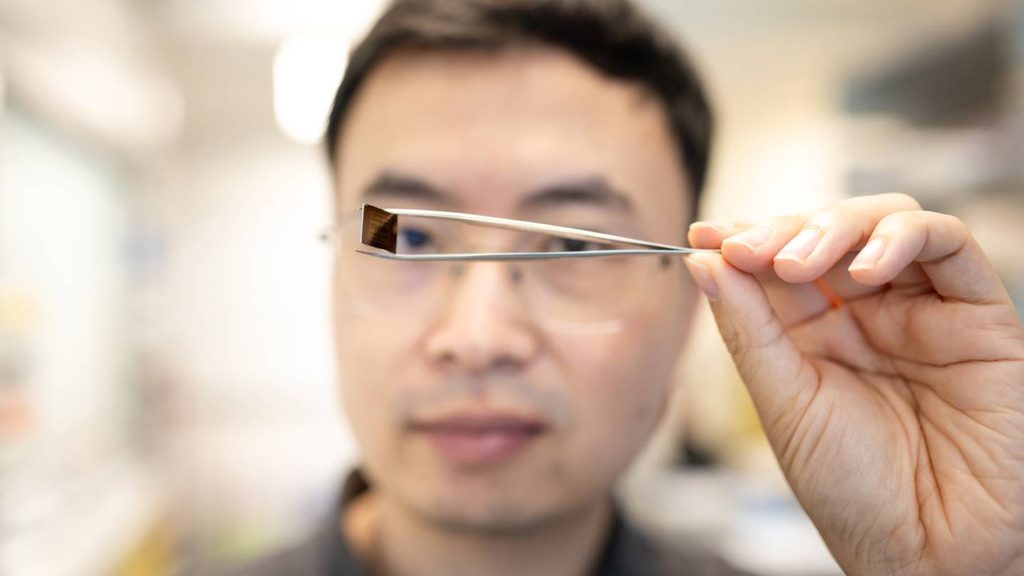
Researchers at Princeton Engineering have developed an ultrathin semiconductor that can repeatedly change its electronic and optical properties in response to light. The material is only a few molecules thick and could eventually enable more adaptable sensors, optoelectronic devices, and computing systems.
Unlike conventional semiconductors, whose electrical behaviour is largely fixed during manufacturing, the material can be reconfigured using different wavelengths of light. The researchers achieved this by combining a two-dimensional semiconductor with light-responsive molecules that change their structure when exposed to light.
These molecular changes alter the semiconductor’s electronic properties, allowing its conductivity and optical response to be programmed, erased, and reprogrammed. The response is also not limited to a binary on-off state. It can be adjusted gradually and then reversed.
The approach could offer a different path for semiconductor development as conventional scaling approaches physical limits. Instead of relying only on making devices smaller, researchers are exploring materials that can introduce new functionality.

The team has produced a uniform piece of the semiconductor measuring one inch square. Using this material, the researchers have built arrays of programmable electronic switches. The next step is to connect these switches into a functional circuit, moving the technology towards larger integrated systems.
The material’s behaviour comes from the interaction between the ultrathin semiconductor and its light-responsive molecules. Different wavelengths cause the molecules to change structure, which in turn modifies the semiconductor’s electrical and optical properties. This gives the material a way to respond to an external stimulus rather than retaining a permanently fixed state.
“Our long-term vision is to build electronics whose functionality is no longer fixed during fabrication,” says Saien Xie, assistant professor of electrical and computer engineering and the paper’s lead author. “Instead, we want devices whose properties can be dynamically reconfigured after they are made.”