





Two scientific techniques are being used to analyse organic and inorganic components in sweat and explore their links with physical condition.
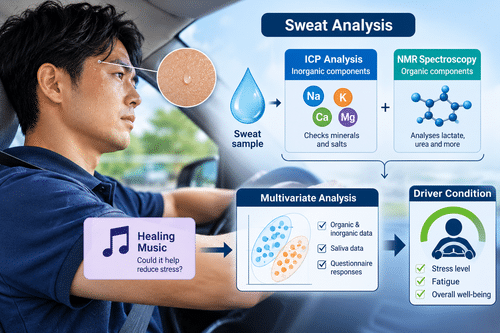
TANAKA MIRAI Lab. of TANAKA PRECIOUS METAL GROUP Co., Ltd., jointly with JAF MEDIA WORKS Co., Ltd. and Della Inc., wants to develop a way to understand a vehicle driver’s physical condition by analysing their sweat components and additional information collected about the driver.
The study focuses on the driver’s sweat, as it contains a range of biological information, including organic components such as lactate and urea, and inorganic components such as minerals and salts. By analysing these components, the researchers think they can understand changes in a driver’s physical condition. The team is using multivariate analysis to study multiple measurements together rather than relying on just one.
The research will also explore whether relaxing music can help reduce stress. Della Inc. will provide healing music for the study. The study will combine data samples collected before and after listening to healing music. The data samples include sweat and saliva samples, as well as questionnaire data. Using multivariate analysis and other methods, the changes in organic and inorganic components will be analysed.
The samples were collected from drivers of JAF MEDIA WORKS’ transport. To collect the sweat samples, a non-invasive extraction method was used. The researchers will use two scientific techniques to analyse the sweat samples. The Inductively Coupled Plasma (ICP) analysis technique analyses the inorganic components of sweat such as sodium, potassium, calcium and magnesium. Whereas, the Nuclear Magnetic Resonance (NMR) spectroscopy technique analyses the organic components of sweat, such as lactate, urea and other organic metabolites.
The researchers aim to analyse several organic and inorganic components along with other data, rather than focusing on one biological component at a time. A single measurement may not provide enough information to understand what is happening in the body. TANAKA is also exploring whether its expertise in precious metal materials and sensing technologies can help develop new ways of detecting biological signals.
