





See how these capacitors reduce components, handle more current, and support power systems used in vehicles and industrial equipment.
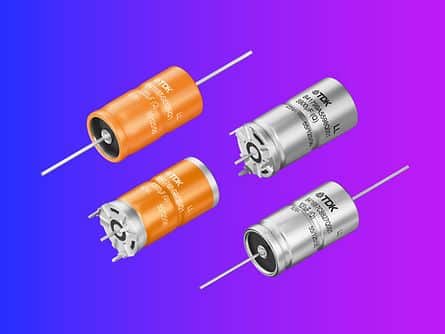
TDK Corporation has expanded its aluminum electrolytic capacitor lineup with new 125 V versions of the B43693/B43793 series and upgraded the 63 V B41687/B41787 series. The capacitors are designed for compact DC-link capacitor banks in 48 V to 120 V battery systems used in small electric vehicles, micromobility platforms, forklifts, electric boats, humanoid robots, automotive electronics, and industrial equipment.
The new series enables higher DC-link voltages with a single capacitor, eliminating the need to connect capacitors in series. This reduces component count and simplifies capacitor-bank design. The series supports ripple currents of up to 21.6 A, operates at temperatures up to +140°C, and offers capacitance values from 56 µF to 650 µF in can sizes ranging from 16 × 25 mm to 21 × 49 mm. It is intended for compact 96 V battery systems operating under high temperatures and dynamic load conditions.
The upgraded B41687/B41787 series uses the same axial and soldering-star construction, enabling a common mechanical design across voltage ratings. It operates at temperatures up to +150°C and offers capacitance values from 510 µF to 4800 µF.
All four series feature low equivalent series resistance (ESR) and high ripple current capability to reduce power losses and improve thermal performance in inverter DC-link stages. They also provide vibration resistance up to 20 g as standard, with up to 60 g available on request. Axial leads and soldering-star terminals support horizontal and vertical mounting on PCBs and busbars.
The company says mounting the 125 V capacitors to a heat sink can more than double their ripple current capability. For example, an 18 × 30 mm capacitor rated for 5.2 A at an ambient temperature of +105°C can handle 11.1 A when its aluminum case is maintained at +105°C, reducing the number of capacitors required and lowering the size and cost of capacitor banks.
Click here for the original announcement.
