




A magnetic sensor development board enables contactless magnetic sensing and supports applications ranging from smart home devices to industrial automation.
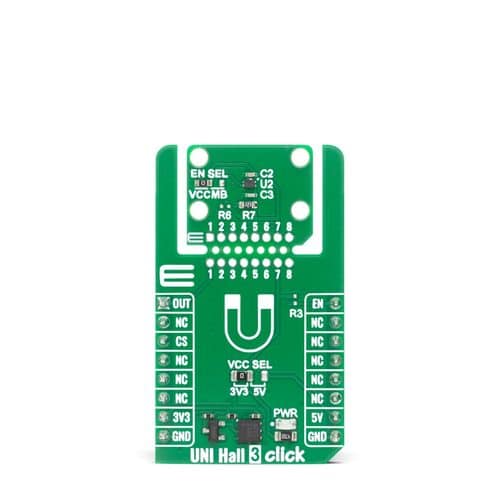
MIKROE has launched UNI Hall 3, designed for magnetic sensing applications. The company claims that the add-on Click board reduces overall development time. The board can also minimise energy consumption with GPIO-controlled modes, such as sleep mode and active mode. The board goes into a low-power sleep state between measurements and returns to the active state when the next reading is required. The target users of the board include individuals and companies working on power-constrained devices, such as smart home devices, human-machine interfaces (HMIs), industrial automation systems and so forth.

The board has a main sensor section, which contains the magnetic sensor, and a mikroBUS base section, which connects the board to the development board or microcontroller. This arrangement is useful as users can detach the sensor from the main board and place it closer to the magnet. This makes installation easy in compact devices or assemblies. It is compatible with the mikroBUS socket and can work with any host system supporting this standard. This ensures integration across a wide range of development hardware.
The release states that the board is based on a nanopower, ratiometric 1D linear Hall-effect sensor from Allegro MicroSystems. The magnetic sensor consumes very little power in sleep mode and switches to active mode instantly when a measurement is needed. This makes it suitable for battery-powered devices and other low-power electronic systems.
The built-in magnetic sensor tracks rapidly changing magnetic field strengths from approximately −2.8 mT to 58.9 mT. The sensor can work in a temperature range from −40°C to +125°C, while magnet polarity and orientation determine the magnetic field.
“UNI Hall 3 Click brings exceptional flexibility and precision to magnetic position detection,” says Nebojsa Matic, CEO of MIKROE. “By combining Allegro’s high-performance Hall-effect sensor with our Click Snap modularity and ClickID automatic board recognition, developers can accelerate prototyping across industrial and smart home applications.”
Click here for the original announcement.
