

A build-it-yourself mobile platform combines cellular connectivity, modular hardware, and AI-assisted programming to help users learn how phones work and create their own applications.
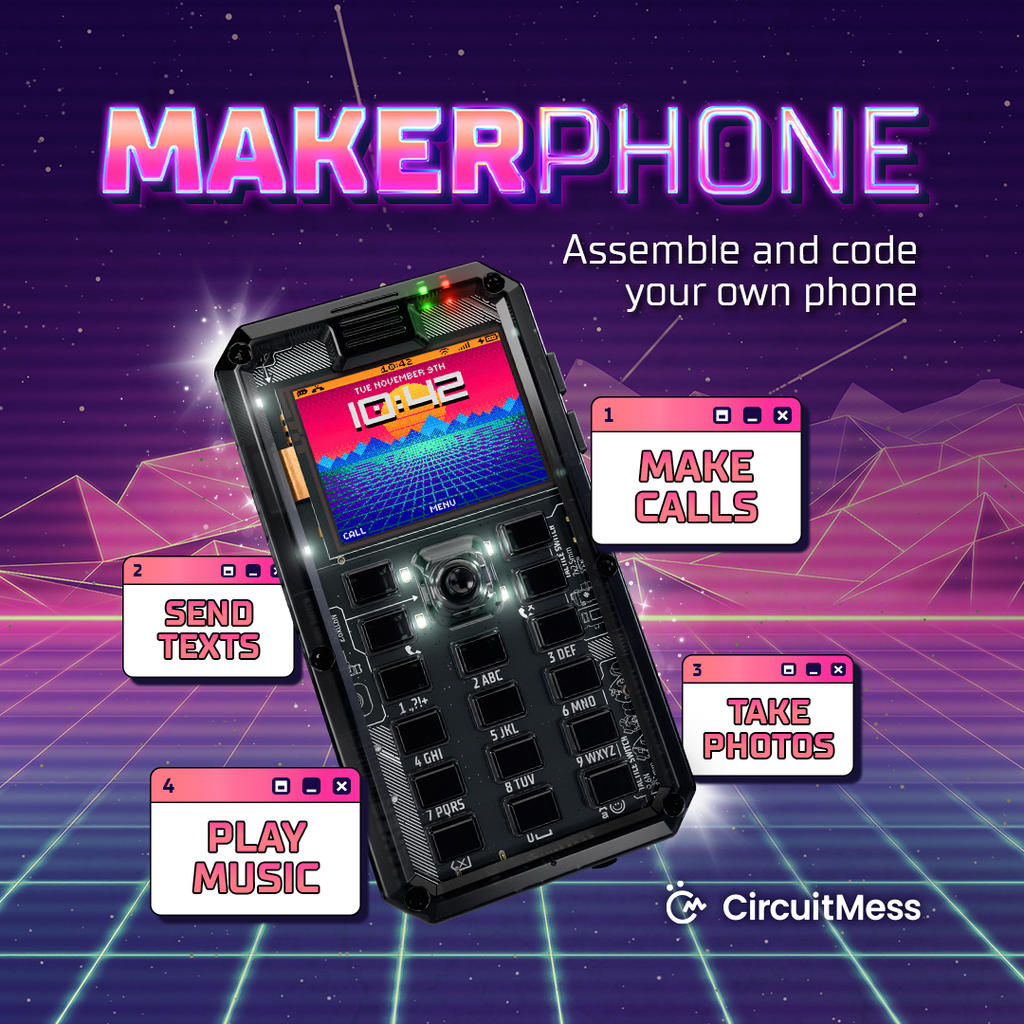
CircuitMess has introduced the MAKERphone 2.0, a build-it-yourself 4G mobile phone designed to combine electronics assembly, programming, and everyday phone functions in a single platform. The device can be assembled in about two hours without soldering or prior electronics experience, after which users can insert a nano-SIM to make calls and send text messages over live cellular networks.
At its core, the MAKERphone 2.0 uses an ESP32-S3 dual-core processor with 4MB flash and 4MB PSRAM. Cellular connectivity is provided through 4G LTE Cat-1 with 2G fallback. The phone features a 1.77-inch colour display, a 12-key keypad, navigation joystick, function keys, speaker, microphone, headphone jack, USB-C charging, and a MicroSD card slot. Wi-Fi, Bluetooth, and USB connectivity support communication and programming.
The key features are:
- ESP32-S3 dual-core MCU architecture
- 4MB flash and 4MB PSRAM
- 4G LTE Cat-1 with 2G fallback
- 1,000mAh rechargeable battery
- USB-C charging and programming
A key feature is its UMAX modular expansion interface, which allows users to add hardware modules including a camera, larger speaker, flashlight, environmental sensing, infrared functions, and a DIY perf board. The modules are automatically detected when connected, allowing the phone to be expanded for experiments, custom circuits, and new applications.
The platform also integrates VibeBoy, an AI-assisted coding studio that lets users describe an idea in plain English and generate code that can be transferred to the phone. Users can then inspect, modify, and progressively write their own programs using MicroPython and C++ through Arduino. The learning system is structured across four skill levels, beginning at age nine and progressing toward independent coding.
Beyond communication, the phone supports a music player, photo and video gallery, file explorer, calendar, alarms, notes, and more than 10 retro games. This makes it applicable to STEM education, classroom activities, electronics experimentation, coding practice, and maker projects, while avoiding conventional app-store and social-media features.
The optional MAKERband smartwatch extends the platform with programmable wearable functionality and can pair with the phone, iOS, and Android devices. The Kickstarter campaign launched in September 2026, with backer deliveries currently estimated for Q3 2027.