




The method uses low-cost sensors and real-time data to predict instability in drones and other engineered systems.
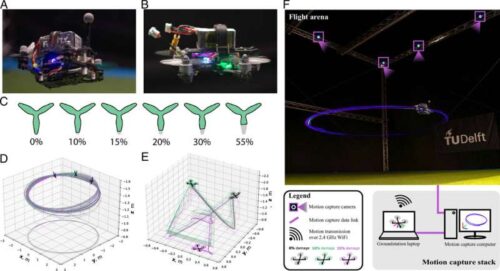
In a new study led by scientists at Delft University of Technology and Wageningen University & Research, an innovative technique that allows for drones and other automated systems to sense instability ahead of loss of control has been devised. This technique utilises early-warning indicators previously used to detect ecosystem collapses, which could improve the safety of drones, aircraft, and autonomous vehicles.
This study, published in the journal Proceedings of the National Academy of Sciences, utilises early-warning indicators that depend on a natural process called critical slowing down. Critical slowing down refers to a situation where a natural system’s ability to withstand disruptions deteriorates and slows its recovery. The researchers found that early-warning signals can reliably indicate when a controlled system is approaching instability.
“You can compare our approach to the way humans experience pain. After an injury, pain provides immediate feedback about our condition and helps us judge what actions remain safe,” says Jasper van Beers, a researcher at Delft University of Technology. “Machines generally lack this form of self-awareness. The new indicators, derived from real-time measurement data, offer a first step toward giving engineered systems a similar ability to recognise when they are approaching their limits.”
For the validation of this idea, researchers performed a set of tests at CyberZoo, a drone testing laboratory at the Faculty of Aerospace Engineering. Scientists deliberately introduced damage and pushed drones to the edge of loss of control, while recording how the faults occur. Using the simulations, flight data analysis and practical experiments, they identified the combinations of the damage, flight conditions and maneuvers that would most probably lead to instabilities.
These indicators can also be used to adapt system behaviour in real time to maintain flight despite damage in a way similar to how people limp when they have an injured ankle. An important feature of this method is that it does not need physical models; it uses data from low-cost onboard sensors.
Van Beers said, “By bringing together knowledge from different scientific disciplines—in this case, aerospace engineering and ecology—we continue to drive breakthroughs that help translate fundamental research into practical technologies.”


