Drones use reinforcement learning to play tag, helping autonomous systems respond to changes during pursuit, evasion, and coordination.
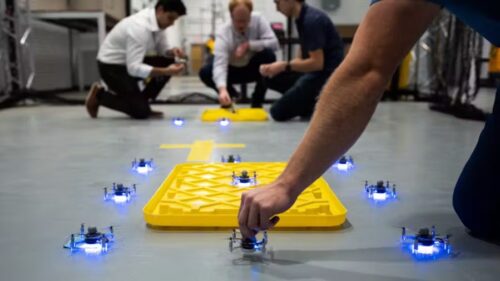
Researchers at the Georgia Institute of Technology and Sandia National Laboratories have used reinforcement learning to teach small drones to play tag, testing how autonomous systems can respond to changing conditions during pursuit, evasion, and coordination.
The researchers trained the drones in simulation by rewarding desired actions and penalising unwanted ones. The process allows the system to learn behaviours that can be difficult to program manually, particularly when conditions change quickly.
The approach is similar to training a dog: actions that produce the desired result receive a reward. For the drones, the reward is recorded by the learning algorithm. By running the system through many simulated situations, the researchers can train it to choose appropriate responses.
One challenge is deciding which behaviours should receive rewards or penalties and how much each should count. This process, known as reward shaping, has a major effect on what the system eventually learns.

The researchers also focused on the gap between simulation and real-world operation. A behaviour that works in simulation may fail on a physical drone because the simulation cannot perfectly represent factors such as hardware limitations and unmodeled movement.
To address this, the team studied the physical drones in detail and used the results to create a more accurate digital model for training. The goal is to identify problems on low-cost hardware before applying the approach to more expensive systems where failures could have greater consequences.
The team tested the method using small, low-cost drones chosen for their quick response and ability to withstand collisions. In the tag game, two pursuer drones defended a fixed base, while two evader drones attempted to reach it without being tagged. The evaders could also force the pursuers into situations where they might collide with each other.
The researchers see the work as a step toward using reinforcement learning for autonomous systems that need to make decisions while conditions are changing rapidly.