




FREE-WILi 2 packs two RP2350 microcontrollers, an FPGA and Raspberry Pi CM0 Linux into a 290-gram handheld hardware tool.
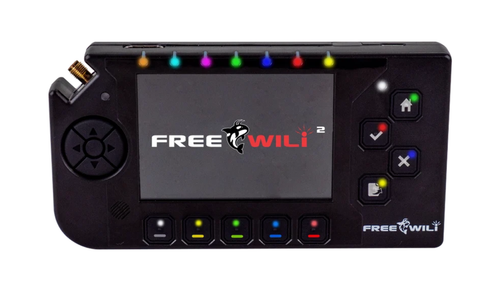
FREE-WILi LLC has opened pre-orders for FREE-WILi 2, an open-hardware handheld electronics multitool designed as a portable laboratory for GPIO, analogue electronics, wireless protocols and retro gaming. The company has published hardware documentation, board support packages and firmware through its documentation platform and GitHub repositories. The Founder Edition is listed at 400 US dollars, with shipping expected to begin in the fourth quarter of 2026.
The unit carries two RP2350 microcontrollers, each paired with 8 MB of static random-access memory (SRAM) and 16 MB of flash storage. Alongside them are a Lattice iCE40UP5K field-programmable gate array (FPGA) with 8 MB of SRAM, a Raspberry Pi CM0 compute module running headless Linux, and a separate STM32WLE5JC microcontroller for LoRa connectivity. An enhanced Raspberry Pi Debug Probe is also built into the device.
This division of processing hardware is central to the design. The RP2350’s programmable input/output (PIO) blocks can handle precisely timed custom interfaces, while the FPGA is intended for workloads requiring parallel hardware processing, including logic capture. The CM0 provides a Linux environment for development and software tools that might otherwise require a separate computer on the workbench.
Wireless coverage spans several protocols. An ESP32-C5 provides Wi-Fi across the 2.4 and 5 GHz bands, while sub-GHz communication is handled by a CC1101 alongside the LoRa radio, which the company states is compatible with Meshtastic. The device also includes 125 kHz RFID, an ST25R3916B controller for near-field communication (NFC), controller area network flexible data-rate (CAN FD) support at up to 8 megabits per second, and infrared transmit and receive functions through a window in the enclosure.
For wired interfaces, FREE-WILi 2 provides 20-pin and 10-pin headers. Its analogue input accepts 0 to 5 volts through an op-amp and programmable-gain-amplifier front end, while analogue output reaches approximately 4.84 volts at 25 kHz. A programmable power supply provides 1 to 5.5 volts at up to 1.5 amperes and includes MOSFET-based protection. The device also includes three USB host ports: two driven by the RP2350 microcontrollers at up to 12 megabits per second and one from the CM0 at up to 480 megabits per second. Each host port’s 5-volt rail can be software-controlled, allowing connected hardware to be power-cycled directly from the device.
The device uses a 3.5-inch capacitive touchscreen with a resolution of 480 by 320 pixels, alongside a five-way D-pad, A/B/X/Y buttons and five context keys. Full-size DVI output is provided through the HSTX interface. Its sensors include a BMI323 inertial measurement unit with magnetometer support, an OPT4001 ambient-light sensor, an SHT40 temperature and humidity sensor, a four-microphone phased array and a 3.5-millimetre audio jack. A 3,000 milliampere-hour battery powers the system through 17 separately managed power zones controlled by a dedicated ultra-low-power microcontroller, with a stated sleep current of 60 microamperes. Storage is provided through two microSD card slots. FREE-WILi 2 measures 152.4 by 78.9 by 22.3 millimetres and weighs 290 grams.
The closest comparison is the Flipper Zero, which covers functions including sub-GHz communication, NFC, RFID and infrared in a smaller and less expensive device. FREE-WILi 2 takes a different approach by adding programmable microcontrollers, an FPGA, a Linux compute module and a more extensive analogue and wired-interface capability.
Against a conventional bench setup, the comparison changes again. Logic analysis, programmable power, protocol debugging and Linux-based tools would normally require several separate instruments and, in many cases, a laptop. FREE-WILi 2 combines many of these functions in a 290-gram handheld device. That makes it expensive for users who only need basic protocol or wireless testing, but potentially useful for engineers and hardware developers who would otherwise carry several tools during site work or field debugging.
At 400 US dollars before shipping and import charges, the final cost in India will be higher than the listed price, although a reliable landed-cost estimate would require confirmation of the product’s customs classification and applicable duties. No Indian distributor is currently listed in the company’s published sales information.
The device’s wireless features would also need to comply with Indian frequency and equipment regulations. India permits licence-exempt operation of certain low-power short-range devices in the 865–868 MHz range, subject to the technical conditions specified by the Wireless Planning and Coordination Wing. The appropriate regional configuration would therefore need to be selected for any sub-GHz or LoRa operation in India. For commercial import and sale, wireless products operating in licence-exempt bands generally fall within the Equipment Type Approval framework administered by the WPC.
The open-hardware approach may be the more significant angle for Indian engineers. FREE-WILi publishes hardware documentation, firmware and related development resources, allowing teams to study and adapt parts of the platform for their own applications. For companies developing field diagnostic equipment for utilities, telecom networks or industrial systems, the published architecture could potentially be more useful than the finished handheld device itself.
Pre-orders are scheduled to ship in the fourth quarter of 2026, so the specifications currently available come from the manufacturer rather than independent testing and should be re-checked against production units. The broader idea behind FREE-WILi 2 may ultimately matter more than any individual specification: a handheld tool can now combine an FPGA, a Linux computer and multiple programmable microcontrollers in a package light enough to carry into the field.
For more information, click here.


