





An edge AI sensor platform combines motion, sound, light, and environmental sensors with on-device AI to process data without cloud connectivity.
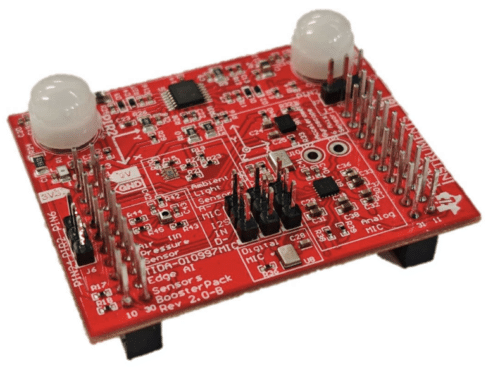
The TIDA-010997 Edge AI Sensor BoosterPack is a reference design from Texas Instruments (TI) that helps developers build edge artificial intelligence (AI) systems using multiple sensors. Designed to work with the MSPM0 LaunchPad ecosystem, the BoosterPack combines environmental, motion, and audio sensing with on-device AI processing. It allows sensor data to be collected, processed, and analyzed locally without depending on cloud connectivity, making it suitable for low-power and real-time applications.
The reference design supports several types of sensors on a single board. It includes an ambient light sensor, a six-axis inertial measurement unit (IMU) with an accelerometer and gyroscope, a digital microphone for audio capture, and environmental sensors for measuring temperature, humidity, and air pressure. Together, these sensors enable applications that require monitoring of movement, sound, lighting conditions, and environmental changes.
A key feature of the design is its support for edge AI. Instead of sending raw sensor data to a remote server, the microcontroller processes information locally and runs machine learning models directly on the device. This reduces response time, lowers communication requirements, improves privacy, and allows the system to continue operating even without an internet connection.
The BoosterPack is designed to connect directly to compatible microcontroller LaunchPad development boards through the standard BoosterPack interface. This modular approach allows developers to combine the sensor board with different controller platforms while using the same hardware ecosystem. The board also provides expansion options through additional connectors, enabling users to integrate external sensors or peripherals when developing custom applications.
The reference design includes firmware, software examples, and support for an edge AI development environment. Developers can collect sensor data, train machine learning models, and deploy them to the microcontroller. The software also supports data logging, sensor configuration, and AI inference, helping reduce development effort when creating intelligent sensing applications.
Communication between the controller and onboard sensors uses standard interfaces such as I²C and I²S, making integration straightforward. The digital microphone uses the I²S interface for audio data, while environmental and motion sensors communicate through I²C. This combination enables simultaneous collection of data from multiple sensing sources.
The reference design targets applications that require local intelligence while operating with low power consumption. Examples include smart home devices, occupancy detection, predictive maintenance, environmental monitoring, wearable electronics, industrial sensing, and consumer products. Motion recognition, sound classification, and environmental condition monitoring can all be implemented using the onboard sensors and AI capabilities.
By combining multiple sensing technologies with embedded machine learning, the reference design provides a platform for developing intelligent edge devices. Its modular hardware, ready-to-use software, and support for local AI inference allow developers to evaluate sensor fusion, prototype AI-enabled products, and shorten development time while building applications that can make decisions directly on the device.
TI has tested this reference design. It comes with a bill of materials (BOM), schematics, assembly drawing, printed circuit board (PCB) layout, and more. The company’s website has additional data about the reference design. To read more about this reference design, click here.

