




Electronic and photonic chips move data differently, with electrons handling computation and light enabling high-bandwidth connections across today’s increasingly demanding artificial intelligence and computing systems.
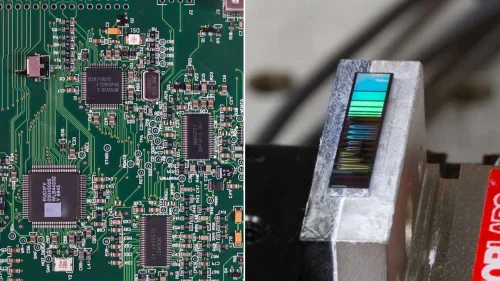
Electronic and photonic chips use fundamentally different approaches to move and process data, with electronic circuits relying on electrical signals while photonic chips use light. The distinction is becoming increasingly important as modern computing systems handle growing volumes of information.
Electronic chips remain the foundation of digital computing. Built mainly using silicon, they use transistors to switch electrical signals, perform calculations, store information and control hardware.
However, moving large quantities of data electrically can consume significant power and generate heat. This challenge is becoming more prominent in data centres, where processors, memory and networking equipment must continually exchange enormous amounts of information.
Photonic chips address the data-movement challenge by using photons rather than relying entirely on electrical signals. Also known as photonic integrated circuits, they can incorporate lasers, waveguides, modulators, filters and photodetectors. Waveguides direct light through the chip, while modulators encode information onto optical signals.
The main advantage of photonics is bandwidth. Light can carry large amounts of information over connections that maintain high bandwidth across long distances. This makes optical technologies attractive for links between processors, memory and networking equipment. Integrated photonics can also bring optical connections closer to computing hardware and potentially reduce energy consumption for some high-speed connections.
Photonic technology does not necessarily replace electronics. Generating, detecting and controlling light requires specialised components, while silicon is not itself an efficient light source. Electronic circuits also remain well suited to many forms of computation, control and logic.
The emerging approach is therefore a combination of both technologies. Electronic circuits can handle dense computation and control, while photonic components move data efficiently between different parts of a computing system. This hybrid architecture could become increasingly important for artificial intelligence and other data-intensive workloads.
