

A dual-arm robot demonstrates human-like throwing, catching, and batting by combining low-inertia mechanical design with force-responsive joints, offering new possibilities for dexterous manipulation and safer physical interaction.
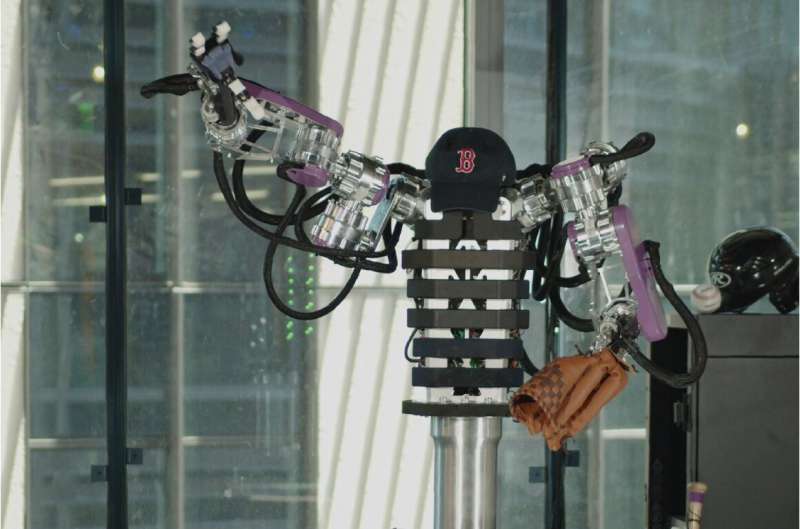
Researchers at the Robotics and AI Institute (RAI), based in Cambridge, Massachusetts, have developed AthenaZero, a dual-arm robotic system capable of throwing, catching, and hitting balls with human-like movements. The system addresses a longstanding challenge in robotics: enabling machines to manipulate moving objects quickly while responding safely to physical contact. Its design combines low-inertia mechanical structures, custom actuators, and force-responsive joints to improve dynamic movement and dexterity.
AthenaZero consists of a central torso, two robotic arms fitted with hands, and a motor-and-gear drive system. Unlike conventional industrial manipulators designed primarily for stiffness and positional accuracy, its arms are engineered to respond to external forces. This allows the robot to absorb and dissipate energy when pushed or when interacting with objects, rather than resisting every disturbance through rigid positioning.
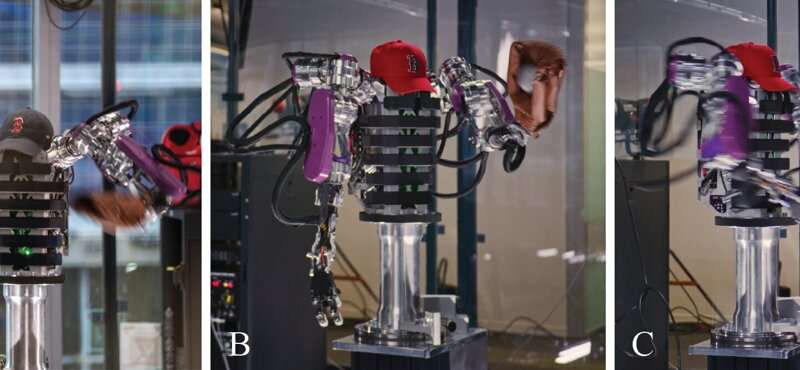
The researchers designed the system around a low-inertia approach, aiming to reduce the effective resistance of the robot’s limbs during movement. This mechanical characteristic is important when handling objects that move unpredictably or require a delicate touch. The joints are backdrivable, meaning external forces can move the arms even when the motors are not actively driving them. When powered, the robot can also adjust its stiffness to suit different interactions.
Testing Coordinated Robotic Movement
The team evaluated AthenaZero using three baseball-inspired tasks: throwing balls, catching them, and hitting them with a bat. These activities test several demanding capabilities, including rapid arm movement, hand-eye coordination, two-arm synchronisation, and controlled physical contact.
Catching a moving ball requires the robot to position its hands accurately while managing the impact force. Batting involves coordinating both arms and controlling the trajectory and timing of the swing. Together, these tasks provide a practical way to evaluate whether a robotic system can combine speed, precision, and compliant interaction.
The work also highlights how advances in electric motors and computational capabilities are helping researchers explore alternative robot architectures. Rather than relying solely on rigid construction and precise positioning, engineers can design manipulators around their dynamic response to the surrounding environment.
The researchers plan to investigate additional manipulation tasks and improve the robot’s ability to handle objects in dynamic environments. Potential applications include industrial assembly, object handling, and tasks involving frequent physical interaction, although these uses will require further validation. The study, titled AthenaZero: A Low-Inertia, Bimanual Robot for Dynamic Manipulation, was published in Science Robotics in 2026. The researchers view the baseball demonstrations as an initial step toward more dexterous robotic manipulation.