





The Syndetis prototype builds from ESP32 uses a WT32-ETH01 module to check network links, detect IP conflicts and identify connected switches through a small OLED display.
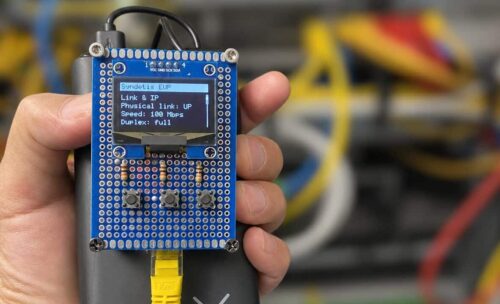
Syndetis is an Ethernet analyser which builds on ESP32 microcontroller. The project is developed by Theocharis Anastopoulos. It comes under the MIT-license. Where the prototype checks Ethernet connectivity, DHCP status, IP address duplicity and connected switch details without a need for a laptop.
The hardware is based on the WT32-ETH01 module, which combines an ESP32 with a 10/100 Ethernet interface and RJ45 connector. There is a display screen of 128×64 OLED resolution with three pushbuttons as input and it uses a USB power bank to supply power.
The firmware executes in the ESP-IDF software framework. It checks the link speed and duplex status, DHCP lease acquisitions, IP conflict detection via ARP probes and performs ICMP pings. It also reads LLDP and Cisco Discovery Protocol (CDP) frames to identify the connected switch and port.
The web interface provides a Wi-Fi hotspot option to enable technicians to use a smartphone to view the diagnostic data and export JSON format. The firmware supports dual OTA partitions with automatic rollback in case of update failures.
To the technicians who work across data centres, enterprise networks and industrial installations, the Syndetis project serves as a low-cost alternative for basic Ethernet troubleshooting. Being open-source, it also provides a starting point for custom network analysers in India where the equipment tends to be very expensive.
Currently Syndetis is a breadboard version. A future version will have their own PCB and enclosure.
For more information, click here.
