

Waveshare’s ESP32-C5-Pico brings dual-band Wi-Fi 6, Bluetooth 5 LE and 802.15.4 to a Raspberry Pi Pico-sized board, with onboard battery charging and prices starting at 8.99 dollars.
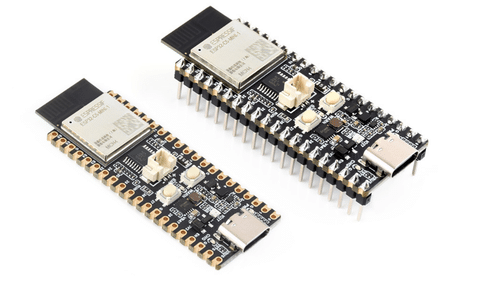
Waveshare has released the ESP32-C5-Pico, a development board built around Espressif’s ESP32-C5 wireless SoC in a Raspberry Pi Pico-compatible form factor. It combines dual-band 2.4 GHz and 5 GHz Wi-Fi 6, Bluetooth 5 LE and IEEE 802.15.4 connectivity with onboard lithium-battery charging.
Waveshare offers four variants. The ESP32-C5-Pico and Pico-M use PCB antennas, while the Pico-U and Pico-UM support external FPC antennas. The M and UM versions have pre-soldered headers, while the standard and U versions leave the headers unsoldered, giving developers options for breadboard prototyping or integration into custom hardware.
Pico-footprint wireless boards have traditionally focused on 2.4 GHz connectivity. The Raspberry Pi Pico W and Pico 2 W, along with many ESP32-based boards, use the 2.4 GHz band, where Wi-Fi, Bluetooth and other devices compete for airtime. In dense residential environments, multiple nearby access points can make the band increasingly congested.
The ESP32-C5 adds dual-band 2.4 GHz and 5 GHz Wi-Fi 6 while retaining Bluetooth 5 LE and an IEEE 802.15.4 radio for protocols such as Zigbee 3.0 and Thread. This gives a compact development board access to the three main wireless technologies used by many connected-home and IoT projects.
The ESP32-C5 uses a single-core 32-bit RISC-V processor running at up to 240 MHz. The chip provides 384 KB of SRAM, 16 KB of low-power SRAM and 320 KB of ROM, while the Waveshare board includes 4 MB of SPI flash. It exposes 20 multifunction GPIOs through its Pico-compatible headers and adds seven I/O lines through an onboard TCA9554PWR GPIO expander. Interfaces include UART, I2C, SPI, ADC and PWM.
Power management is also built into the board. A lithium-battery charging circuit and 3.7 V battery connector allow the board to operate from an external Li-ion or Li-polymer cell without a separate charging board. Programming and serial communication are handled through USB Type-C, with development supported by Espressif’s ESP-IDF and the Arduino IDE.
A Raspberry Pi Pico 2 W offers a dual-core processor and 2.4 GHz Wi-Fi but does not provide 5 GHz Wi-Fi or an IEEE 802.15.4 radio. An ESP32-C6 adds 802.15.4 support for Thread and Zigbee, but its Wi-Fi remains limited to 2.4 GHz. The ESP32-C5 instead combines dual-band Wi-Fi with Bluetooth and 802.15.4 in a similar compact embedded platform. Its more modest processing and memory resources make it better suited to connectivity-focused sensors, controllers and gateways than compute-intensive applications.
The 5 GHz capability is relevant in India because specified portions of the band are available for licence-exempt low-power use under conditions set by the Department of Telecommunications. Permitted frequencies, power levels and operating conditions vary by band, so developers turning the board into a commercial product must check the current regulatory requirements rather than treat the entire 5 GHz range as licence-free. Applicable WPC and telecommunications-equipment requirements also depend on the final product and its configuration.
The 8.99-dollar price is a starting point for the development board, not an Indian landed cost. Shipping, taxes and import charges can increase the final price. Even so, the board provides a relatively inexpensive route to experimenting with 5 GHz Wi-Fi without moving to a larger Linux-class platform or adding a separate wireless module.
For Indian smart-home and agritech developers, the ESP32-C5-Pico offers a compact way to experiment with dual-band connectivity alongside Bluetooth and 802.15.4. Its main attraction is not raw computing power but the combination of wireless interfaces in a Pico-compatible board, particularly for applications where 2.4 GHz congestion makes another Wi-Fi band useful.
For more information, click here.