




An ESP32-based smart clock uses LED displays and voice alerts to remind elderly users about medication and other daily tasks.
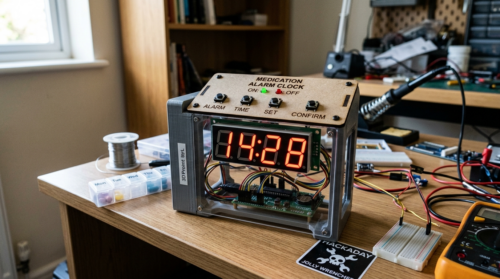
A hobbyist known as hvermaak has built the Ouma Ria Smart Clock, an ESP32-based project intended to help users keep track of medication and other everyday activities. The project is documented on Hackaday.io and was later featured by Hackaday. What began as a basic clock gradually developed into a broader reminder system covering medication schedules, birthdays and kitchen timers.
The clock is powered by an ESP32-WROOM-32, which manages the display, reminder schedules and a web interface for configuration. Four 8 × 8 WS2812B addressable light emitting diode (LED) matrix panels form the main display, while a separate 30-LED WS2812B strip provides status indications. A DS3231 real-time clock module maintains time independently of the ESP32, and a BH1750 ambient light sensor adjusts the display brightness according to the surrounding light. Audio notifications are handled by a DFPlayer Mini module, while two AM312 passive infrared (PIR) sensors provide movement detection for presence-based functions.
Reminders and other settings can be managed through the web interface without having to reflash the firmware. The builder has also expanded the project beyond medication reminders, adding birthday notifications, kitchen timing functions and basic presence-based security features. This turns the original clock concept into a general-purpose device that can be placed on a shelf or countertop.
Commercial medication reminder solutions include smartphone applications and dedicated hardware, with some services requiring subscriptions. The Ouma Ria approach instead uses commonly available electronics and local processing to provide reminders through a physical display and audio alerts without depending on a subscription.
The project is a hobbyist build rather than a certified medical device, and reproducing it requires experience with soldering and ESP32 or Arduino-based firmware. The documentation describes a web interface for configuring the clock but does not clearly specify its authentication or access-control features. Anyone adapting the design should therefore check how the interface is protected before connecting it to a shared home network.
Because the hardware and software are openly documented, the project can also serve as a starting point for developers and hobbyists interested in building customised reminder or assistive devices. The Hackaday.io project page provides the build information, wiring details and firmware needed to study or modify the design.
For more information, click here.


