

A U.S. regulatory clearance allows compatible wireless earbuds to provide hearing-aid functionality, bringing personalised hearing support to a familiar consumer device.
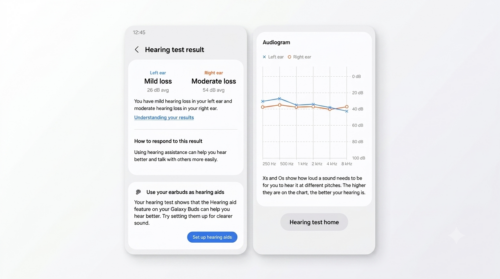
Samsung’s Galaxy Buds Hearing Aid feature has received U.S. Food and Drug Administration (FDA) clearance, allowing compatible earbuds to provide hearing-aid functionality for adults aged 18 and above with perceived mild-to-moderate hearing loss. The feature combines a self-administered hearing test with personalised sound processing, bringing functions traditionally associated with hearing aids to a consumer earbud platform.
The system includes a five-minute Hearing Test that uses clinical-grade pure-tone audiometry to test each ear and generate an audiogram. Samsung says the resulting audiogram has accuracy comparable to a professional audiologist’s evaluation. The Hearing Aid feature then adjusts amplification according to the user’s hearing profile, including sounds such as high frequencies, whispers and distant voices. It also uses noise reduction and beamforming, while NAL-NL2 is used to personalise amplification. The Hearing Aid and Hearing Test features are scheduled for the Galaxy Buds3 Pro and Galaxy Buds4 Pro in the U.S. and select approved markets in Q4 2026.
The distinction between this type of device and a basic sound amplifier is important. A basic amplifier raises the volume of incoming audio without distinguishing between frequencies. Hearing aids can instead adjust amplification across the frequency range according to a user’s hearing profile. An audiogram provides this profile by measuring hearing sensitivity at different frequencies. Products designed only to make surrounding sounds louder fall into the category of Personal Sound Amplification Products (PSAPs) rather than hearing aids. Unlike FDA-regulated hearing aids, PSAPs are not intended to compensate for hearing impairment and are not regulated as medical devices for that purpose.
The development follows the FDA’s creation of an over-the-counter (OTC) hearing-aid category in 2022 for adults with perceived mild-to-moderate hearing loss. OTC hearing aids can be purchased without a prescription or audiologist visit, while still providing controls for adjusting amplification to the user’s needs. Traditional hearing aids, by comparison, typically involve a hearing assessment, device programming and follow-up adjustments by a hearing-care professional.
Consumer earbuds are therefore moving some parts of the hearing-aid process into software and familiar personal devices. Smartphone-connected models can combine hearing assessment with personalised sound processing, reducing the need for dedicated hardware for users who fall within the intended hearing-loss range. Samsung’s approach uses NAL-NL2, a recognised formula for fitting hearing aids, together with the earbuds’ microphones and signal-processing capabilities to adapt sound to the user’s hearing profile.
An OTC hearing aid is not a substitute for professional hearing evaluation. Samsung states that its Galaxy Buds Hearing Aid feature is intended for adults with perceived mild-to-moderate hearing loss and is not intended to replace diagnosis or treatment by a healthcare professional. These features are therefore aimed at a specific range of hearing needs rather than replacing clinical care for people with more severe hearing loss.
The potential audience is large. The World Health Organization estimates that more than 1.5 billion people currently live with some degree of hearing loss, with the number projected to reach nearly 2.5 billion by 2050. WHO also identifies factors including cost, limited access to hearing-care services and stigma as barriers to receiving appropriate hearing care.
Hearing aids in India can range from around ₹20,000 to more than ₹300,000 per ear, depending on the technology and features. WHO India estimates that approximately 63 million people in the country have significant auditory impairment. India’s medical devices are regulated under the Medical Devices Rules, 2017 through the Central Drugs Standard Control Organisation (CDSCO), but an OTC hearing-aid framework equivalent to the category introduced by the U.S. FDA has not been identified in the current Indian regulatory framework. If Samsung or Apple eventually bring their hearing-aid features to India, hearing assessment and personalised amplification could become available through wireless earbuds rather than requiring a separate dedicated device.
For more information, click here.