Could freezing a liquid inside an optical fibre improve how efficiently light and sound exchange information? Researchers demonstrated a more than 1000-fold increase.
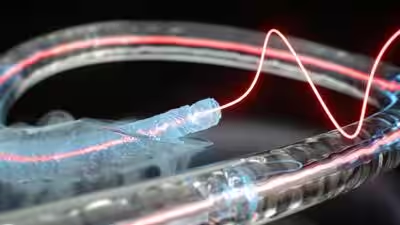
Researchers from the Max Planck Institute of the Science of Light, Leibniz University Hannover, and the Leibniz Institute of Photonic Technologies have demonstrated a more than 1000-fold increase in the interaction between light and sound by freezing the liquid core of a specialised optical fibre.
The team used a liquid-core optical fibre, in which a liquid material replaces the conventional solid core. By cooling the liquid to around −196°C using nitrogen, the researchers turned it into a solid while the fibre continued to guide both light and hypersonic sound waves.
This change in the core created a tightly confined environment that significantly strengthened the coupling between optical and acoustic waves. Using Brillouin-Mandelstam scattering, the researchers measured light-sound interaction more than 1000 times stronger than that observed in conventional optical fibres.
The enhanced interaction also enabled an optoacoustic memory demonstration. Information carried by a fast optical wave was transferred to a much slower acoustic wave, temporarily stored there, and then converted back into light. This provides a way to manipulate optical information using the difference in propagation speeds between light and sound.

Freezing the liquid also changed physical properties such as its density and refractive index, producing stronger nonlinear optical effects inside the fibre. The researchers see this as a new platform for controlling interactions between light and sound in compact photonic systems.
The approach could eventually support photonic and neuromorphic computing, quantum information processing, microwave photonics, and precision sensing. Stronger light-sound coupling could be particularly useful for photonic systems where information needs to be transferred or temporarily stored with low energy consumption.