




Researchers developed a humanoid robot framework that adapts to human partners, reducing back strain while improving safety, movement efficiency and collaborative lifting performance together.
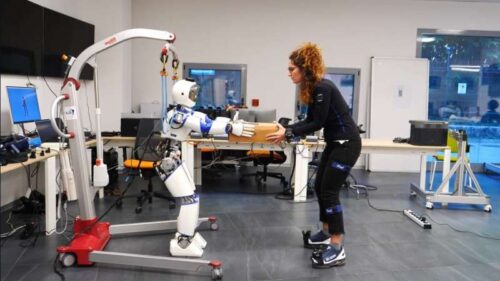
Researchers at GenerativeBionics, the Italian Institute of Technology (IIT) and the University of Manchester have developed a design framework for humanoid robots that enables them to adapt to human partners during collaborative lifting. The approach was demonstrated using the ergoCub robot and aims to reduce lower back strain while improving safety and efficiency in shared manual tasks.
Unlike conventional robot design, which often separates hardware development from control software, the new framework jointly optimises a robot’s body structure and intelligence. The researchers model the robot, its human partner and the task as a single interconnected system, allowing the robot to predict and respond to a person’s movements and physical characteristics.
Using this methodology, the team created ergoCub, whose body was specifically designed to minimise biomechanical loading on a human partner while maintaining efficient locomotion. Its control system continuously updates an internal model of the person using sensor measurements, enabling the robot to follow movements, adapt to different users and monitor ergonomic indicators during collaborative lifting.
Tests showed that people working alongside ergoCub experienced significantly lower estimated stress on the lumbosacral region of the lower back compared with performing the same task alone. The robot also demonstrated faster and more energy-efficient walking than earlier versions, highlighting the benefits of simultaneously designing physical structure and control architecture.
The researchers describe this concept as ‘shared embodied intelligence’, in which a robot’s hardware, sensors, actuators and control software are developed together rather than independently. They believe this integrated approach can improve both robot performance and human wellbeing in workplaces where people and robots collaborate closely.
Future work will refine the design framework and apply it to new humanoid platforms, including Gene.01, with the long-term goal of creating robots tailored to sectors such as manufacturing, logistics, inspection and healthcare while reducing occupational strain and improving human-robot collaboration.
