

Humanoid robots are entering factory testing as real-world training expands towards large-scale deployment across automotive manufacturing facilities, supporting future autonomous material handling and assembly tasks.
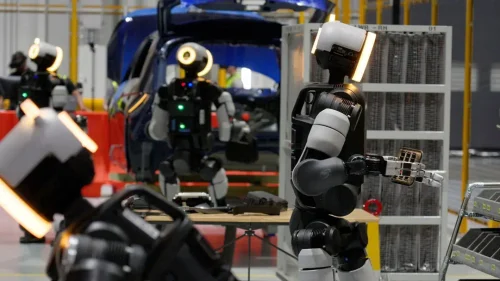
Boston Dynamics has begun factory testing of its Atlas humanoid robot at Hyundai Motor Group’s Robotics Metaplant Application Center (RMAC) in Georgia, US, as the companies prepare the system for broader manufacturing deployment. Atlas is being trained in real production environments for automotive parts logistics, sequencing and other industrial tasks.
RMAC, located inside Hyundai Motor Group’s Metaplant America campus near Savannah, serves as a dedicated testbed and training centre for physical AI and robotic applications. Human trainers are currently teleoperating Atlas in factory conditions to teach it how to handle automotive components, organise parts and support assembly-line operations.
The initial focus is on logistics and parts sequencing, with plans to expand Atlas applications towards component assembly by 2030. The robots are also being trained for repetitive motions and strenuous activities, including lifting heavy loads. This approach allows the system to gather operational data and adapt its behaviour before wider deployment across manufacturing facilities.
Hyundai Motor Group plans to deploy 25,000 Atlas units across Hyundai and Kia facilities globally over the coming years. To support this scale, the group also plans a dedicated US production facility capable of producing up to 30,000 robots annually.
Atlas is designed for industrial environments, with a 1.9m height, 2.3m reach, 56 degrees of freedom and a sustained payload capacity of 30kg. It can operate for up to four hours and autonomously exchange its battery, supporting extended factory operation.
The RMAC will expand into a facility around ten times larger in 2027, while Boston Dynamics plans to investigate Atlas applications beyond automotive manufacturing. Potential sectors include aerospace, semiconductor manufacturing, logistics, food and beverage, and life sciences.
The programme remains focused on training and deployment expansion, with real-world testing intended to establish reliable robotic workflows before wider industrial adoption.