

A new robotics model trained on human video could help humanoid machines learn physical tasks faster, reducing reliance on manually collected robot training data sets.
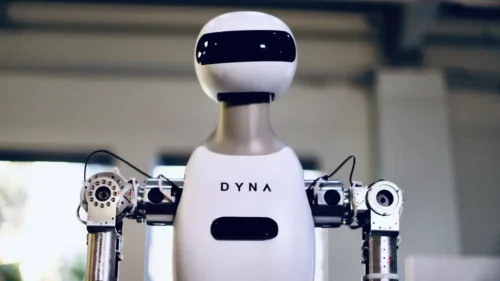
Dyna Robotics has introduced DYNA-2, a robotics foundation model trained on more than one million hours of human video to help robots learn physical tasks. The company says the approach could address a major challenge in robotics: the limited availability of manually collected robot-action data.
The model, developed by the Redwood City, California-based company, uses human egocentric video rather than relying primarily on demonstrations performed by robots. Dyna says the dataset represents roughly 170 years of continuous waking experience, giving the system a large source of information about how people interact with objects and their surroundings.
DYNA-2 uses a world-modelling architecture combining next-frame and next-action prediction. Instead of learning solely from robot movements, the system uses human video to develop an understanding of how physical environments change and how objects respond to movement.
This approach is intended to make robot training more scalable. Knowledge learned from human behaviour can potentially transfer between different types of robotic hardware, with the company saying DYNA-2 can be adapted to new platforms with limited local fine-tuning.

In testing, Dyna reported that the model increased task success in high-precision manufacturing from about 20 per cent to 90 per cent through greater pre-training scale. The system also demonstrated transfer across stationary robot arms, humanoid prototypes and dexterous robotic hands.
One demonstration required only 13 minutes of data for two five-fingered robotic hands to twist open a bottle cap. Across 15 benchmark tasks, models trained with more human video reportedly performed more consistently.
The company also reported improved resilience when physical disturbances disrupted tasks. During activities such as chopping food and clearing workspaces, DYNA-2 could recover without human intervention, while the earlier model required manual recovery.
Dyna says the technology could ultimately help robots learn new physical tasks without requiring vast quantities of robot-specific training data, supporting broader deployment across manufacturing, hospitality and other environments.