




Humanoid robots are entering factories, but established industrial machines still offer speed, reliability and proven economics for many demanding production tasks worldwide today at scale.
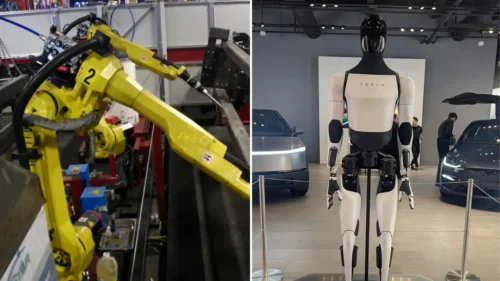
Humanoid robots are gaining attention as a flexible option for factory automation, with Apptronik’s Apollo illustrating how a human-shaped machine could work in spaces built around people. However, conventional industrial robots still perform most automated factory work and retain important advantages in established production environments.
The central opportunity for humanoids is flexibility. Factories contain stairs, carts, shelves, tools and workstations designed for human workers, making a human-shaped robot potentially useful without requiring major changes to conveyors, protective cages or other infrastructure. A single machine could also perform several jobs, such as delivering components, tending a machine and inspecting parts during a shift.
Industrial robots, meanwhile, have a formidable lead. Factories installed 541,000 industrial robots in a year, while the operational worldwide total reached roughly 4.6 million. Decades of deployment have created ecosystems covering software, component suppliers, safety specialists and systems integrators. Manufacturers can calculate returns for familiar applications such as painting, palletising and assembly.
Specialisation remains another strength. When a production task rarely changes, a machine optimised for that operation can be faster, more reliable and easier to maintain than a humanoid. Collaborative robots have also narrowed part of the gap by working more closely with people and supporting flexible tasks.
Humanoids could therefore complement rather than immediately replace conventional systems. Their strongest role may emerge where factories cannot justify rebuilding a production line for irregular work or where automation cannot easily handle human-oriented surroundings.
The future factory is likely to use both approaches. Industrial robots can continue handling repetitive, high-volume operations, while mobile systems and humanoids take on tasks requiring movement, adaptability and interaction with existing environments. The deciding factors will be capability, reliability, safety, integration costs and whether a flexible platform can deliver value to justify deployment.
