




Researchers have developed a hybrid polymer binder that strengthens lithium-ion battery electrodes, improves durability and energy density, while remaining compatible with existing manufacturing processes.
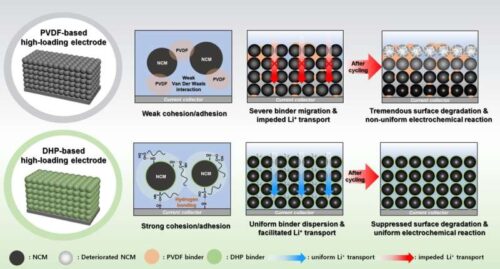
Researchers at Sungkyunkwan University (SKKU), working with Seoul National University, have developed a hybrid polymer binder that could significantly improve the performance and lifespan of lithium-ion batteries for electric vehicles (EVs) without requiring changes to existing production lines. The technology combines two polymers to create a stronger, more stable electrode structure, addressing a long-standing challenge in manufacturing high-capacity batteries.
Modern EV batteries increasingly rely on thicker, nickel-rich electrodes to store more energy. However, conventional polyvinylidene fluoride (PVDF) binders tend to migrate during the drying process, weakening the electrode, reducing lithium-ion transport and causing cracks that shorten battery life. These issues have limited efforts to increase battery capacity using existing wet-manufacturing techniques.
To overcome this limitation, the research team combined spandex with poly(acrylic acid) to form a dual-acting hybrid polymer binder. The new material provides stronger adhesion and improved molecular interactions, helping the electrode maintain its mechanical integrity even at greater thicknesses. It also promotes more uniform lithium-ion movement by forming an interface that enhances ion transport during battery operation.
Laboratory testing showed that electrodes using the hybrid binder achieved nearly twice the adhesive strength of conventional binders. Commercial-grade pouch cells retained 86.8 per cent of their original capacity after more than 200 charge-discharge cycles, whereas cells using traditional binders experienced a rapid decline and failed after around 95 cycles. This represents a substantial improvement in operational lifespan.
A key advantage of the new binder is its compatibility with existing wet-processing manufacturing lines, allowing battery manufacturers to improve energy density and durability without investing in new production equipment. The researchers believe the approach could accelerate the development of longer-range EVs while reducing manufacturing costs and simplifying industrial adoption.

