





Can in-cabin cameras deliver sharper infrared imaging without increasing system cost? A compact sensor targets wider adoption of driver and occupant monitoring.
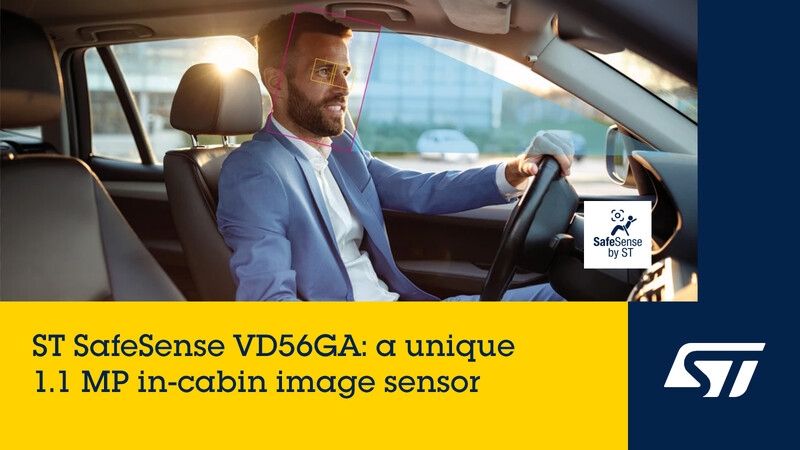
STMicroelectronics has introduced a 1.1 MP automotive image sensor for infrared in-cabin sensing, targeting driver and occupant monitoring systems across higher-volume vehicle platforms. The device combines improved infrared sensitivity, embedded processing, and a compact package to help camera designers balance image quality with system cost and integration requirements.
The sensor uses ST’s DeepNIR backside-illuminated pixel architecture, developed for infrared imaging. Compared with the previous generation, it delivers 35% higher modulation transfer function (MTF) sharpness and nearly 60% higher quantum efficiency. The improvements are intended to support clearer imaging in demanding in-cabin applications, including cameras positioned behind displays.
The higher imaging performance can also influence the wider camera design. According to ST, the sensor can support lower-cost optics, simpler infrared illumination, less demanding optical filtering, and eliminate the need for external image-processing resources. This could help OEMs and Tier 1 suppliers develop smaller and more cost-conscious camera modules for broader vehicle deployment.
The device is housed in a 3.7 × 3.2 mm CSP package, making it suitable for space-constrained camera installations. Its embedded processing functions include mirror, crop, dark calibration, auto exposure, and piecewise-linear processing. These functions can reduce the processing burden on the rest of the camera electronics while simplifying system integration.
Support for both RAW and YUV outputs also allows the sensor to fit into different electronic and software architectures. This gives developers flexibility in how image data is processed and integrated into vehicle sensing systems.
“In-cabin sensing is moving beyond premium platforms, and carmakers need cost-effective solutions they can deploy broadly. With VD56GA, we focused on the system-level tradeoffs that matter most: image quality in infrared conditions, compact integration, and a cost structure that supports high-volume programs,” says Alexandre Balmefrezol, Executive Vice President and General Manager of the Imaging Sub-Group at STMicroelectronics.
Click here for the official announcement.

