

A tiny levitated rotor spins for hours with minimal energy loss, offering a promising route towards stable inertial navigation where satellite signals cannot be trusted.
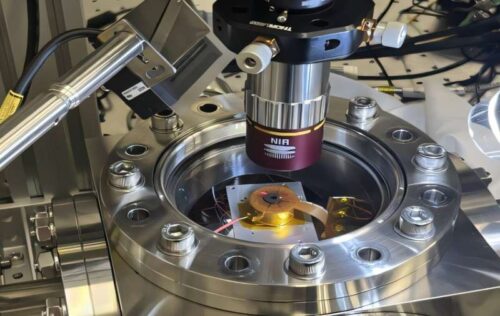
A*STAR’s Quantum Innovation Centre has developed a levitated, millimetre-scale rotor that could support navigation when global positioning system (GPS) signals are unavailable. The device continued spinning for more than 10 hours after its drive was switched off, demonstrating exceptionally low rotational energy loss for a mechanical rotor of its size.
The platform uses passive magnetic levitation in a high-vacuum chamber, allowing the rotor to spin with very little friction. Researchers used real-time control and precisely applied electrostatic forces to accelerate it to 930 revolutions per minute. Its prolonged rotation provides the stability needed for sensitive measurements of orientation and movement.
The system detected rotations as slow as 0.0065 degrees per second, putting its sensitivity within the commercial-grade range for gyroscopes. Further modelling suggests the technology could eventually reach navigation-grade performance with additional development. That could make it useful for vehicles operating where satellite-based positioning is unreliable or unavailable, including autonomous underwater systems.
Gyroscopes are central to inertial navigation because they allow vehicles to track changes in orientation without relying on external signals. Improving the stability of their spinning element can therefore extend accurate navigation in challenging environments.
Developed by A*STAR Q Inc, the platform combines millimetre-scale passive levitation, room-temperature operation, high spinning speed and record-low rotational energy loss at this scale. The team plans to increase the rotor’s spinning speed, improve stability and reduce the size of supporting systems.
The longer-term goal is an affordable, commercially viable sensor platform for real-world navigation. The research, published in Nature Communications, highlights how advances in precision engineering, levitation physics, sensing and control could translate fundamental research into practical navigation technology.