




Researchers demonstrated a liquid-based computing system using oscillating microparticles, revealing an energy-efficient approach capable of analysing complex data and detecting subtle anomalies accurately.
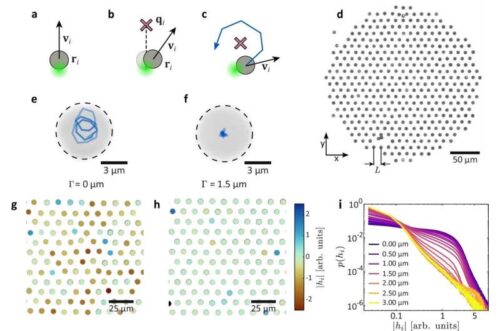
Researchers at the University of Konstanz and the University of Stuttgart have demonstrated a novel computing approach that uses hundreds of microscopic particles oscillating in a liquid instead of conventional electronic circuits. The study, published in Communications AI & Computing, suggests that complex physical interactions can process information while consuming less energy than traditional computing methods.
Rather than relying on billions of transistors switching in carefully controlled ways, the experimental system harnesses the collective motion of fluid-coupled microparticles. Researchers feed input data into the particle array, allowing interactions within the liquid to generate rich physical patterns that naturally encode complex information. Selected features from these dynamics are then analysed to produce computational results.
The technique is based on reservoir computing, an unconventional computing method that exploits the natural behaviour of physical systems instead of performing every operation digitally. According to the researchers, the liquid-based reservoir reliably responded to input signals despite its intricate dynamics, demonstrating that highly accurate computation can emerge without requiring complete control over every microscopic interaction.
In laboratory tests, the system successfully predicted chaotic time series and detected extremely subtle anomalies hidden within noisy datasets. Such capabilities could prove valuable for analysing seismic measurements, environmental monitoring records and other real-world data where small changes may indicate significant events.
The researchers believe the findings could contribute to the development of energy-efficient computing technologies for edge devices, where processing data locally is increasingly important. By allowing physical systems themselves to perform information processing, future computing hardware could reduce power consumption while maintaining strong analytical performance.
Although the current demonstration remains a laboratory model, the study highlights the potential of liquid-based microparticle systems as an alternative computing platform. Further research will focus on improving scalability, reliability and practical integration before the technology can be considered for real-world applications.

