An MCU supports two displays, 3D graphics, startup in less than 150 milliseconds, low-power operation, and safety features.
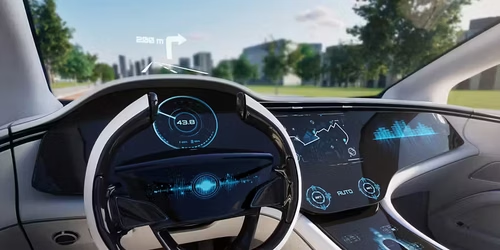
Infineon Technologies has introduced the TRAVEO CYT4EN microcontroller (MCU) for automotive instrument clusters and display systems, including two-wheelers. The MCU supports external LPDDR4 memory and can handle graphics and display functions that are typically implemented using more complex system-on-chip (SoC) platforms.
The CYT4EN can render 2.5D graphics and 3D scenes, drive displays with resolutions up to Full HD, and control two displays simultaneously. Its integration is intended to reduce system complexity and the bill of materials compared with SoC-based designs.
The MCU supports deterministic boot times of less than 150 milliseconds. This can help applications that require faster startup than the multi-second boot times associated with some complex SoC platforms.
For graphics processing, the CYT4EN supports on-the-fly rendering and hardware-accelerated decompression. Infineon worked with Micron to optimise the MCU’s memory subsystem for LPDDR4, allowing the device to support graphics workloads while maintaining system efficiency.
The CYT4EN is based on the TRAVEO T2G architecture and combines processing, graphics, functional safety, and security features in a single MCU. It supports functional safety up to ASIL-B under ISO 26262 and was developed in accordance with ISO 21434 for automotive cybersecurity.
An independent voltage domain allows functions such as communication and basic processing to remain active during low-power modes. This can reduce the need to keep the entire system running when full processing performance is not required.
The integration can also reduce the number of devices required in smart cockpit designs. The MCU can handle system management and in-vehicle network communication without additional microcontrollers for these functions. It can support PCB designs with as few as six layers, while its power efficiency can allow designs without active cooling.
“Cutting-edge cluster and display solutions are playing a central role for the user experience in connected and software-defined vehicles,” said Thomas Boehm, Senior Vice President Automotive Microcontrollers at Infineon. “With TRAVEO T2G CYT4EN, we are helping our customers bring them to market more quickly, efficiently and cost-effectively. By combining the simplicity, safety, and fast responsiveness of an MCU architecture with the high-bandwidth memory required for modern cockpit graphics, we are enabling a new generation of vehicle displays.”
Click here for the original announcement.