




Researchers have developed non-invasive muscle radar sensors that could improve prosthetics, exoskeletons and rehabilitation by measuring muscle force accurately in real time.
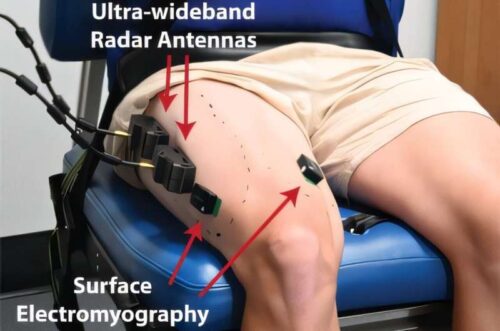
Researchers at the University of Queensland have developed a non-invasive muscle sensing system that uses ultra-wideband radar to measure muscle force, potentially improving robotic limbs, prosthetics and wearable assistive devices. The findings, published in Science Robotics, could enable future mobility technologies to respond more accurately to a user’s movements without invasive procedures.
The research team says the new sensors measure electromagnetic changes inside muscles as they contract, allowing muscle force to be monitored directly. Unlike current assistive technologies, which often rely on external motion or pressure measurements, the radar-based approach provides a more precise indication of how much assistance a person requires.
Lead researcher Christopher Bird said there has previously been no reliable non-invasive method of measuring the mechanical forces produced by muscles during contraction. By capturing this information, robotic limbs and exoskeletons could determine not only when to assist users but also how much support to provide.
The sensors are worn on the skin, where ultra-wideband radar antennae transmit electromagnetic pulses into muscle tissue. The reflected signals change as muscles contract, enabling researchers to estimate muscle force without inserting probes or electrodes into the body.
The technology could have applications beyond robotics. Researchers believe it may improve rehabilitation programmes, injury prevention and recovery, while helping clinicians make better-informed treatment decisions. It could also assist athletes by identifying the safest time to return to training after injury, reducing the risk of reoccurrence.
The next stage of the project is to enable real-time force measurement, allowing the sensors to serve as direct inputs for prosthetic limbs and other assistive devices. If successful, the system could pave the way for smarter wearable technologies that adapt instantly to a user’s movements, delivering more natural, responsive and personalised assistance for people with mobility impairments.

