

Scientists used neutron imaging to study friction stir welding, revealing ways to reduce residual stress and develop stronger, more durable steel armour for defence.
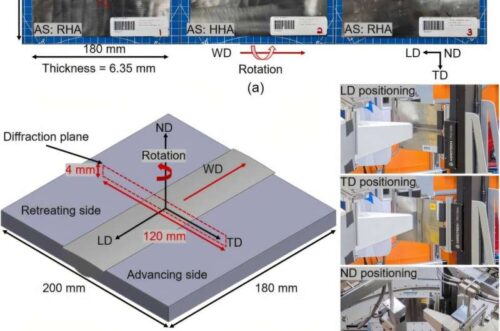
Researchers from The Ohio State University and the US Department of Energy’s Oak Ridge National Laboratory (ORNL) have used neutron analysis to investigate how friction stir welding can strengthen steel armour while reducing weaknesses created during conventional welding. The findings, published in the Journal of Materials Processing Technology, could improve the durability and ballistic performance of armoured vehicles.
The team examined residual stress generated during friction stir welding, a solid-state joining process that uses a rotating tool to create heat through friction rather than melting the metal. Unlike traditional welding, the technique minimises the softening of hardened armour steel, helping preserve its protective properties.
According to the researchers, conventional welding often creates weakened zones that require additional reinforcement, increasing both weight and manufacturing costs. Friction stir welding offers an alternative by producing stronger joints while reducing these drawbacks.
To understand how stresses form within welded samples, the researchers used ORNL’s high flux isotope reactor and its high intensity diffractometer for residual stress analysis (HIDRA). Neutrons can penetrate deep into steel, enabling scientists to measure internal residual stress with far greater detail than many conventional inspection methods.
The data gathered will help researchers refine computer models and optimise welding parameters for armour manufacturing. By identifying how different welding conditions influence stress distribution, engineers could develop joining techniques that produce more reliable and resilient protective structures.
The next phase of the project will compare friction stir welded samples with conventionally welded armour steel and conduct ballistic testing to determine how residual stress affects real-world performance. Researchers hope the work will establish a roadmap for manufacturing stronger armour systems that combine improved protection with lower weight and greater durability, benefiting future defence applications and other industries that rely on high-performance steel structures.