

A new dry electrode manufacturing process promises enhanced battery performance while reducing manufacturing costs and environmental impact.
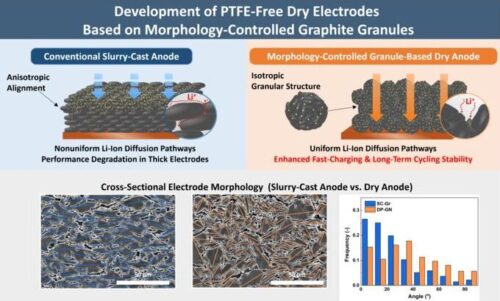
Scientists from the Korea Institute of Materials Science (KIMS) and the Korea Electrotechnology Research Institute (KERI) have successfully created Korea’s first shape-controlled graphite granule-based dry electrode manufacturing technology for highly-performing batteries, which does not rely on polytetrafluoroethylene (PTFE). The technology is expected to extend electric vehicles (EVs) driving range, reduce charging time and accelerate the commercialisation of environmentally friendly battery manufacturing processes.
The scientists designed an innovative PTFE-free anode, which combines a commonly used binder system of CMC-SBR with a novel graphite particle structure. Composite graphite granules were fabricated through spray drying from the slurry, which contained graphite, conductive additives, and binders. In contrast to typical plate-like graphite particles, the novel granules are characterised by an isotropic inner structure, creating multidirectional lithium-ion transport pathways, including through plane pathways across the electrode thickness.
The experimental studies demonstrated that the proposed dry anode had better fast charging capabilities and cycling stability compared with conventional slurry-based anode. Additionally, the technology enhanced lithium ion diffusion in the high energy density state and therefore, confirmed its potential for enabling high-capacity batteries based on thick-electrode architectures.
Applications of the technology will be in electric vehicles, energy storage systems (ESS), and next-generation high-energy-density batteries. Being developed using the CMC-SBR binding system that has already been commercialised by the industry, the technology can also be supported by large-scale manufacturing while reducing manufacturing costs and carbon emissions.
“This technology presents a new approach capable of overcoming the limitations of conventional PTFE-based dry-electrode processes,” said Jihie Yoon, senior researcher at Korea Institute of Materials Science. “We expect it to be highly applicable to next-generation EV batteries that require both high energy density and fast-charging performance.”